Christian Hypnotherapy for Anxiety and Panic Attacks

The 3am awake mind. The chest that won’t unclench at the school carpark. The prayer you’ve prayed twice and don’t yet feel.
If you’re a Christian dealing with anxiety, you already know it doesn’t respond well to being told to just trust God. The trust is real. The fear is also real. Both are happening at once, and one isn’t cancelling the other. That’s not a failure of faith. That’s how anxiety works.
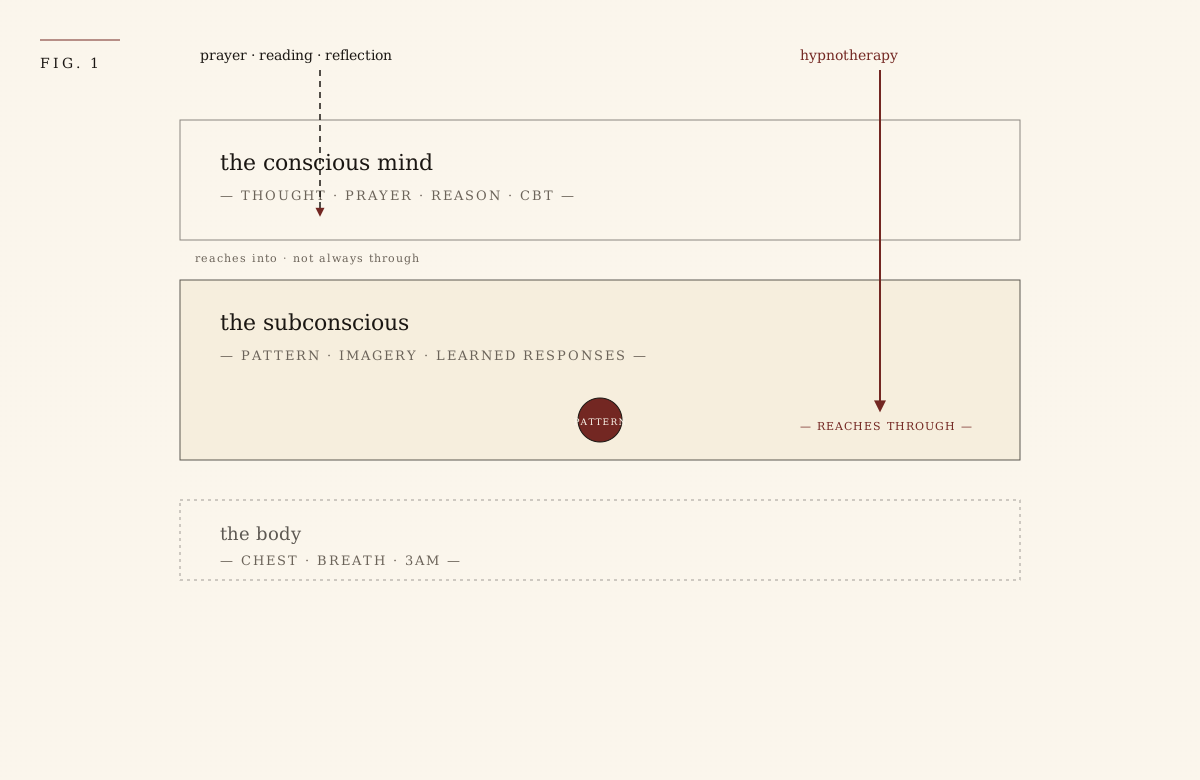
This page explains how Christian hypnotherapy reaches the layer of the mind where anxiety actually lives — the layer that prayer reaches into, but that talking-and-deciding can’t quite touch.
Why Anxiety Doesn’t Listen to the Part of You That Knows Better
Anxiety is not a thinking problem. By the time you can reason with it, it’s already happening in your body — the chest, the breath, the tight jaw, the racing heart. Your conscious mind, the part that knows Romans 8 and can quote do not be anxious about anything, is one floor up from where the alarm bell is ringing.
The bell is being rung by an older part of your nervous system. It’s been trained — sometimes over decades, sometimes by a single hard moment — to read certain cues as danger. School pick-up. The work email. The Sunday family lunch. The empty bedroom at midnight. Your conscious mind reasons with it; it doesn’t listen, because reason isn’t what trained it.
This is why so many faithful, prayerful Christians come to hypnotherapy after years of trying everything else — counselling, breathing exercises, journalling, more prayer. None of those things are wrong. They reach the part of you that already knows what it should do. They don’t always reach the layer underneath.
How Hypnotherapy Reaches That Lower Layer
In a hypnotherapy session, I guide you into a focused, relaxed state — the same state your mind enters during deep prayer or biblical meditation. The brain calls it the alpha-theta range. Scripture calls it being still. In that state, the lower layer of the mind — the part that runs your habits and reactions on its own — becomes available for new instructions.
Then, gently, we start replacing the trained alarm patterns with new ones. The chest that tightens at the school carpark learns to soften. The 3am mind learns that its job at 3am is to sleep. The body learns that the situations it has been treating as emergencies are not emergencies.
You stay fully aware the whole time. You can hear me. You can reject anything I say. You remain in control. There is no surrender of will — only structured work with the part of your mind that has been running on outdated instructions.
How a Christian Session Differs From a Generic One
The differences are not cosmetic. They are about who is in the room and what enters the suggestions during the focused state:
- Scripture-anchored suggestions. Generic anxiety hypnotherapy uses affirmations like “I am safe, I am calm, I am enough.” In a Christian session, those become “The peace of God, which transcends all understanding, will guard your hearts and your minds in Christ Jesus” (Philippians 4:7), or “Cast all your anxiety on him because he cares for you” (1 Peter 5:7). These land differently because they are words you already trust.
- Imagery from your own world. Visualisations are drawn from passages you already know — the still waters of Psalm 23, the renewing of the mind from Romans 12:2, the lilies of the field. You don’t have to filter New Age imagery on the way out.
- A practitioner who shares your faith. When the work is shaped by someone whose worldview is Christian, you don’t have to wonder whether the practitioner thinks your faith is part of the problem. The conversation that opens each session is about what you’re carrying and what God might be doing in this season of your life.
What Anxiety Hypnotherapy Can Help With
Hypnotherapy is well-suited to most forms of anxiety:
- Generalised anxiety — the constant low-grade dread that sits in the background of normal life
- Panic attacks — the acute episodes that arrive without warning, often physical (chest pain, shortness of breath, dizziness)
- Social anxiety — the dread of being seen, judged, or having to perform in social situations
- Health anxiety — recurring fear that something is medically wrong despite normal investigations
- Performance anxiety — fear before public speaking, work presentations, exams
- Sleep-related anxiety — the 3am mind that won’t quiet, or the dread of going to bed
- Anticipatory anxiety — fear about events that haven’t happened yet, often weeks or months in advance
- Anxiety connected to past trauma — present-day responses that are about the past more than the present
Many clients also find that anxiety is intertwined with another issue — an addiction that started as self-medication, a relationship strain that grew from an anxious attachment style, or chronic pain that has both physical and emotional components. Sessions can address all of these together.
What to Expect From the Sessions
Most clients notice meaningful change after the first session. The total number depends on what you’re working through.
- A focused single issue — a particular trigger, a recent panic attack, a specific fear — often resolves in 2-3 sessions.
- Generalised anxiety that has been building for years usually takes 4-6 sessions, sometimes more, to substantially shift.
- Anxiety connected to trauma typically lives in the Restore package range — five sessions allow for the deeper work of resolving the underlying material, not just managing the symptoms.
A typical session runs about 60 minutes. We start with a conversation — what’s been hard, what you’ve tried, what God seems to be doing in this season. Then I guide you into the focused state and we do the deeper work. Most clients describe the state itself as profoundly relaxing — many say it’s the most rested they’ve felt in months. You leave with the work continuing in the background, often noticing changes in the days that follow.
Sessions are available online worldwide — Australia, the United States, the United Kingdom, South Africa, anywhere with a stable video connection — or in-person at the Eltham, Melbourne clinic.
Frequently Asked Questions
Does hypnotherapy work for anxiety?
Yes. Clinical hypnotherapy has a strong evidence base for anxiety disorders. Multiple meta-analyses have shown it produces significant reduction in anxiety symptoms, often comparable to or better than cognitive behavioural therapy. It works particularly well for the bodily, automatic dimensions of anxiety that talk therapy alone struggles to reach.
How is this different from medication?
Medication acts on brain chemistry to dampen the alarm system. Hypnotherapy retrains the alarm system itself. Many clients use both — medication to keep symptoms manageable while the deeper work happens, then taper off as the underlying patterns shift. Always coordinate medication changes with your prescribing doctor.
Will I have to relive past trauma?
No. Christian hypnotherapy for anxiety doesn’t require you to re-experience the difficult material in detail. The work happens at the level of the patterns that the past installed, not by forcing you to re-walk every step of how they got there.
Can I do sessions online?
Yes. Online sessions via video call are just as effective as in-person work for anxiety. You can do them from your own home, in a chair you already trust, with no commute and no waiting room.
Is hypnotherapy a sin?
No. Read the complete answer in our guide — but in short: hypnosis is a focused mental state, not a spiritual practice. When the suggestions used in that state are drawn from Scripture, the practice honours rather than compromises faith. Focus on the Family states there is “no reason to regard [hypnosis] as evil or dangerous in and of itself.”
The Next Step
If anxiety has been carrying you instead of you carrying it, the next step is a no-obligation 20-minute discovery call. We’ll talk through what’s been happening, what you’ve tried, and whether this work might fit. There’s no pressure — only clarity about what’s possible.
You can also take the quiz for an indicative read on what you might be working with, or read the complete guide to Christian hypnotherapy for a deeper view of the practice.
The next step is a conversation.
A 20-minute discovery call to see whether we should work together.