We meet once a week online. Five sessions. About sixty minutes
each. You sit at home, comfortable and in control. No commute.
No waiting room. No pretending a flare day is a normal day just
so you can get to an appointment. Chronic pain already takes
enough out of the house. Online sessions matter more here than
they do in plenty of other conditions.
Session 1 is history, measurement, and your
first introduction to the focused state. I listen and map the
case. When did the pain begin? What was happening in the body
when the pain started? What has imaging shown? What has imaging
not shown? Did you have surgery, decline surgery, or get told
surgery would not help? What are you taking now — opioids,
Lyrica or Gabapentin, Cymbalta or
Endep, NSAIDs, muscle relaxants? What have you tried
beyond medication? Where is the pain loudest? Where does the
pain ease off?
Your brain-pain pathway is specific to your life. A back signal
is not a knee signal. An old-injury signal is not the same as
pain with no clear starting point. A leg-and-ankle pattern has
different cues from a shoulder or neck pattern. We measure your
baseline with a numerical pain rating and a short
activity-impact check. Then I introduce the focused state.
People often expect to be “under.” Most
people are awake and aware. You hear me. You can reject anything
I say. The focused state feels a bit like being absorbed in a
good book — narrowed attention, calm, and easy to come
back from at any point.
Sessions 2 to 4 are the core retraining
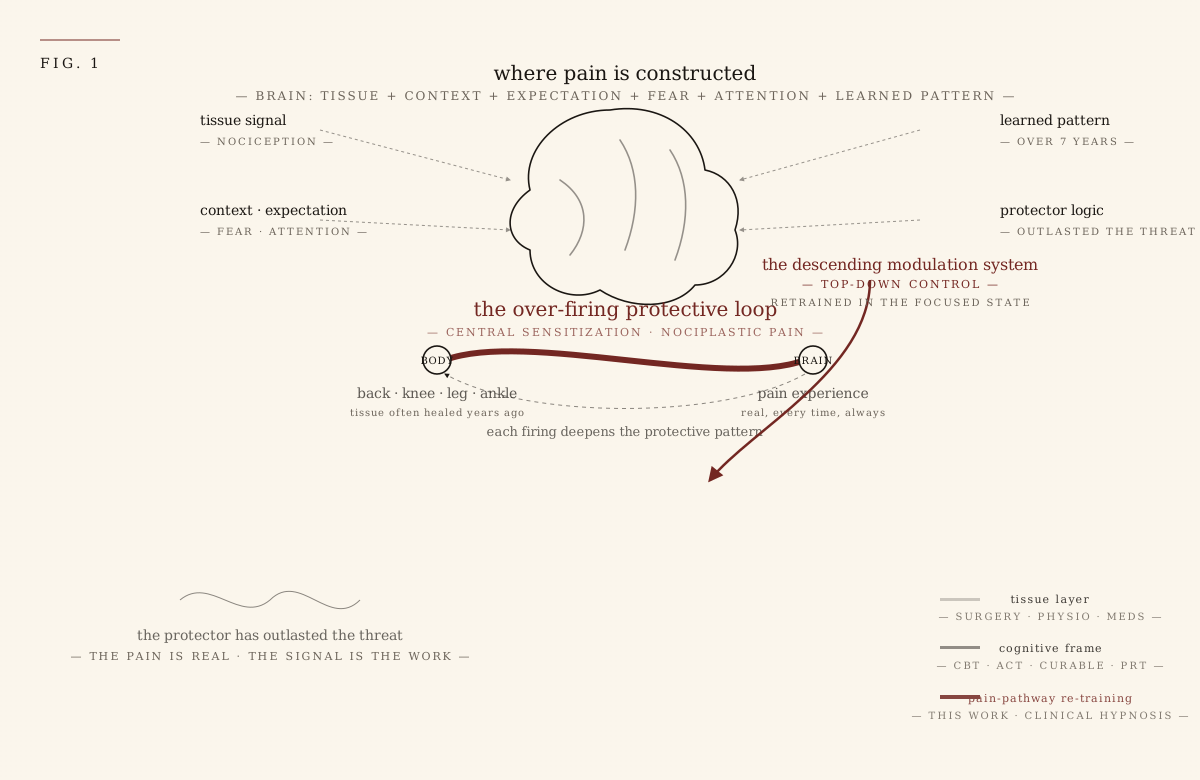
sessions. We work with the sensitised protective signal —
the pain pathway the nervous system over-learned — and we
work on retraining the over-firing. The pain is real; what we
retrain is the over-firing, not the pain.
I use imagery and suggestion calibrated to your pain region.
Back pain uses one family of images and cues. Knee pain uses
another. Leg-and-ankle pain uses another. I also calibrate the
sessions to the triggers your signal has learned —
movement, posture, time of day, weather change, a stressful
conversation, or a memory tied to the original injury.
Between sessions, you listen to audio recordings most days.
Those recordings are not filler — they keep training the
pathway between our meetings. Many people start to notice shifts
by session two or three: a morning that does not begin with the
pain check, a walk taken without counting the steps. Some
people take longer. The practice still matters. The brain keeps
working on what we have started, both during each session and
in the days between.
Session 5 is review and close-out. We look at
what settled and what still feels sticky. We take the new
response into real life — a workday, a drive, the bend to
pick something up — because relief has to matter where you
actually live. We talk through what to do if the signal tries to
lift again. Flares can happen. You will know how to respond. We
re-take the measurements so you can see what changed. No
subscription. Five sessions, keep the tools, live your life.
Some cases need the seven-session Transform extension
instead of the five-session Restore protocol. I usually
consider Transform when pain has been running longer
than ten years, when several pain patterns have layered together
across decades, when post-surgical pain sits on top of the
original injury, or when session five shows a partial response
and two more sessions clearly make sense. The discovery call
decides the starting route. If you begin Restore and
Transform becomes the right extension, the additional
two sessions are billed at the per-session rate.
Most clients see meaningful relief by session five. A few
respond partially — pain reduction that does not erase the
pain but makes the day workable again. A minority do not
respond. We check progress as we go. On the slim chance there is
no movement by mid-protocol, usually around session three, we
talk plainly about whether to continue, switch to the longer
protocol, or refer elsewhere. If we stop, remaining sessions are
refunded. You have a strong chance of meaningful relief.
Hypnotherapy is fully compatible with whatever you and your
doctor have decided about — opioids, gabapentinoids like
Lyrica and Gabapentin, antidepressants for
pain like Cymbalta or amitriptyline, NSAIDs, muscle
relaxants, physiotherapy, and any procedures already planned.
You stay on your medication. As the brain-pain pathway calms,
many clients find they need less medication. But that decision
belongs with your prescribing doctor and you.