“As a Christian I didn’t believe in hypnosis. But what Charles does is not like magic or evil — it is simply resetting your brain to its original functions. I am 65 and struggled for years. Now I am happy and dealing with life in the Christian manner.”
“I poured before I knew I'd decided to.”
Your discipline isn't broken. I promise.
The drink-cue has its own pathway — and the pathway can be retrained.
Five- to seven-session online hypnotherapy for adults whose evening pour has stopped serving them and will not stop on willpower.
Charles Lobo — Clinical Hypnotherapist. Diploma, Australian Academy of Hypnosis. Member, Australian Society of Clinical Hypnotherapists. Cue-pathway hypnotherapy. Online. Five sessions. Multi-session relational protocol — not a one-shot.
Start Here
The Things She Has Already Tried
The morning starts the same way. She wakes at 3am with her heart pounding — the cortisol-rebound wake, on schedule, four nights out of seven. She lies there. She drifts off again at half past four. The alarm goes at 6:30 and the day begins behind itself. The kettle. The school run. The meeting at ten she gets through on coffee and competence. By 4pm she is thinking about wine. By 5:55pm she is walking to the kitchen for water and finds the bottle open before she has noticed herself opening it. I poured before I knew I'd decided to.
Hold that line a moment. It is the cleanest thing anyone has said about what is actually happening. We will come back to it.
Anna is forty-seven. A bottle most nights. Sometimes shared with her husband; sometimes the second half on her own after he has gone to bed. The first glass before dinner. The second with. The third while tidying up. Sometimes a fourth. She does not stumble. She does not miss work. She is not the woman in the kitchen at midday with a glass — that woman is, in the family mythology, the line and she is well clear of it. I am not an alcoholic. I just drink too much. She has said the line to her husband, to her own reflection, to herself in the kitchen at nine o'clock with the second bottle half down. The line has been recited so many times it has hardened into a fact about the kind of woman she is.
She has tried more than people give her credit for. Dry January four times — the third year she ran it as a forty-day stretch and was proud of it; she was back at the bottle by Valentine's. This Naked Mind on her bedside table, annotated in two colours; she read it again last winter and underlined the same passages and poured a glass that night anyway. The Allen Carr book somewhere in the study. The Reframe app, used diligently for the first fortnight, drifted into a graveyard of unopened notifications, deleted in March. The kombucha and the Lyre's in the fridge as the swap that works half the time. The conversation with her husband that ended — I think I'm drinking too much — both of them nodding and nothing changing. The wedding photo from her cousin's, the one she scrolled past quickly. The doctor who said the GGT was a little high and let's re-test in three months and she thought yes and drove home and poured one anyway.
Then her seven-year-old asked, on a Tuesday, with the deliberateness only a seven-year-old has — Mum, why do you have wine every night? She finished the bottle that night. The next afternoon, in the school carpark, while the kids were doing pickup, she Googled in incognito.
What she has not yet been told, by any of the books or any of the apps or any of the failed Dry Januarys, is this: none of those failed attempts are evidence that her discipline is broken. None of them. Each one is data — about which cues the pathway has wired, about which moments fire it, about what cognitive reframe alone cannot reach. I am not an alcoholic. I just drink too much is the sentence the audience says about itself, and the page that disagrees with the first half is the page that loses her at the line. She is right about the first half. The diagnosis the second half is reaching for — that the problem is volume, that the problem is willpower, that the problem is moral — is the wrong diagnosis. The problem is the cue-pathway. And the cue-pathway can be retrained.
None of those failed attempts are evidence that her discipline is broken. Each one is data — about which cues the pathway has wired, about which moments fire it.
What the drinking is actually doing
Here is what the cessation field has learned about drinking in the last fifteen years that has not made it onto most pages.
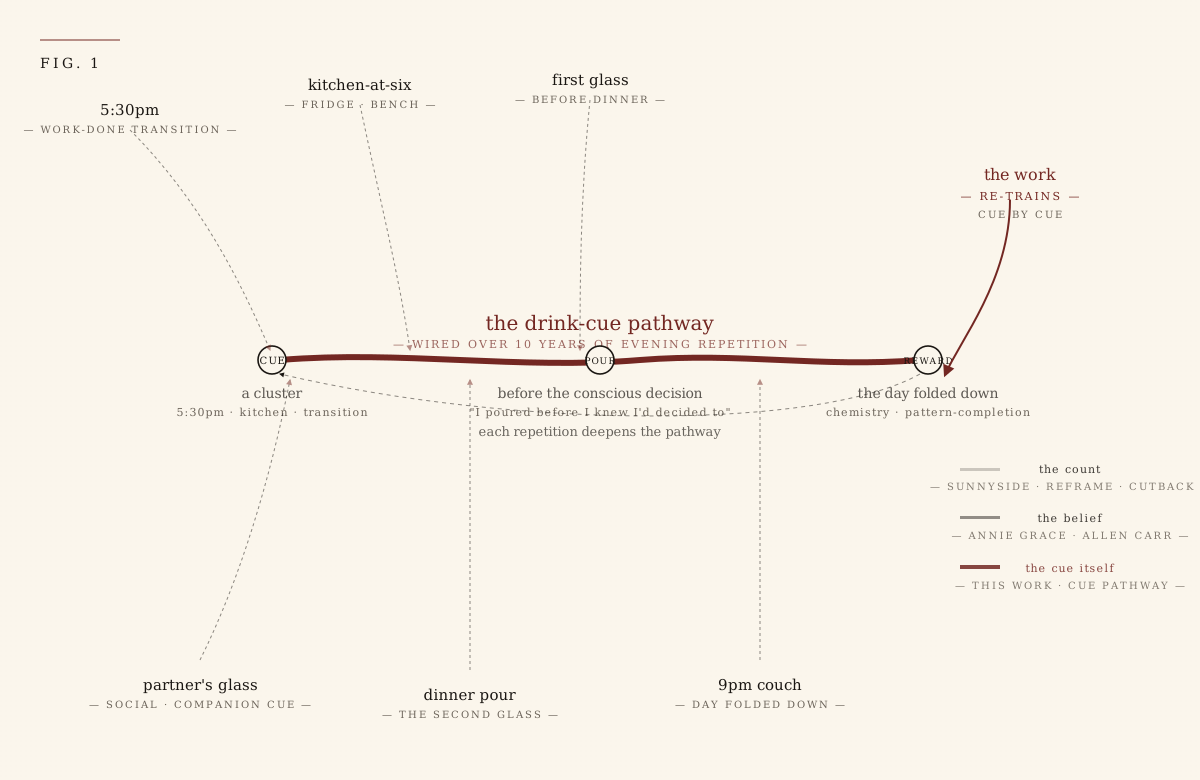
The wine is not the problem. The wine is the substrate. What has been wired, over five or ten or twenty years of evening pouring, is a pathway — a learned cue-and-response circuit in the older, deeper part of the brain, the part that runs without asking permission. Each evening, at roughly five-thirty or six, a cluster of cues arrives together. The work is over for the day. The kids are doing homework or screen time. The kitchen smells like dinner that hasn't started. The wine fridge is two metres from the bench. The first glass goes in at six. The second goes with the meal. The third is the while-tidying-up glass. By nine the bottle is gone and the day's tension is folded down into the couch. The next day the cues arrive again, and the pathway, deepened by yesterday's repetition, fires a fraction faster. A pathway, fired four thousand times across a decade, becomes the road the body takes by default. The conscious I want one arrives after the hand has already moved. I poured before I knew I'd decided to is not a metaphor and it is not a confession. It is the audience accurately describing the operation of a pathway that runs below conscious access.
Three things follow from that.
The first is that discipline has not been the problem. Every successful Dry January has, paradoxically, deepened the pathway, because the resumption — the day-32 glass, the Valentine's glass, the I have earned this glass — is the reach-for-the-bottle behaviour repeated under cue, and repetition under cue is exactly what wires the road. This is not a failure of character. It is what happens when a pathway is asked to dissolve under conditions that keep it firing. It is the wrong tool for the actual layer.
The second is that the apps — Sunnyside, Reframe, Cutback Coach — are not wrong; they are partial. Tracking shifts behaviour for some clients, especially in the early days. For most, after a fortnight, the tracking layer makes the drinking more conscious without changing the cue. The reach-at-six still happens; the count is more visible; the count is no less automatic. The phone records what the older brain has already decided.
The third is the load-bearing one, and it is worth taking carefully. This Naked Mind and The Easy Way to Control Alcohol both do work that was a generation ahead of the cessation field. Annie Grace and Allen Carr, in different idioms, recognised that willpower was the wrong frame and that the cognitive belief about wine was where the leverage lived. They were right. For some readers, the cognitive reframe is enough — the belief shifts and the desire goes with it. For most, the belief shifts and the cue still fires. I read This Naked Mind and I get it intellectually — why am I still drinking? is the most common single sentence the audience says about the book, and it is not a verdict on the book. It is a description of a cue-pathway that does not require belief in order to fire. The pathway is wired below the level of belief, in the part of the brain that learned to pair five-thirty-pm with the kitchen-and-the-bottle and has been firing on schedule ever since. Annie Grace's work is the cognitive layer. The work this page describes is one layer below — the cue itself, in the focused state where it can be spoken to.
A separate note, briefly, on naltrexone. The Sinclair Method works on the neurochemical reward layer — when the drink lands, the reward is blunted, and over weeks the pathway is supposed to extinguish. Some clients respond well to it; some find the side effects intolerable; some find that the reward dampens but the cue keeps firing on its old schedule. Cue-pathway hypnotherapy and naltrexone target different layers; some clients work both, with their GP and with me, in concert.
Hypnotherapy targets the cue, not the chemistry and not the belief. The five-thirty transition, the kitchen-at-six, the first glass before dinner, the dinner pour, the 9pm couch — these are what the protocol retrains, cue by cue, calibrated to the trigger profile a particular life has wired.
A 6pm that doesn't pivot to the bottle.
When the cue releases
It is a Tuesday in October. The work has been ordinary. The kids are doing homework. The light through the kitchen window is the same gold it has always been at twenty to six. Anna walks in for water. She fills the kettle and stands at the bench while it boils, looking at the cookbook open on the counter. The wine fridge is where it has always been, two metres to her left. She does not think about it. She makes the tea. She carries the cup through to the lounge. Halfway down the hallway she notices that she did not think about the wine in the kitchen. The not-thinking is the thing she notices, the way someone might notice the absence of a sound that has been there for years.
The 3am wake does not come. The morning begins on time. The Saturday at the park with the toddler is the actual Saturday, the one the couch-hangover used to eat. The dinner with friends ends with sparkling water and a long conversation and the keys in her hand at half past ten and the drive home clear-eyed. The wedding photo from October — different one, a friend's this time — has her face in it and the face looks like the face she keeps in her head when she pictures herself.
The four hours a day that used to be the cognitive load of thinking about wine starting at 4pm — not the wine itself, the thinking — have come quietly back to her. She has stopped counting. She has stopped tracking. She has stopped having the conversation with herself about whether tonight is the night she stops. The endpoint that the discovery call helped her name — for some clients it is sustainable moderation, for some it is full sobriety, for some it is somewhere between, and the work names which one fits her shape — is what it is, and it is not the daily question it used to be.
This is not a different woman. This is the same woman. It is the absence of the bottle as the day's punctuation. It is the absence of the 3am cortisol wake. It is the absence of the 4pm calculation. It is the absence, on a Tuesday at twenty to six, of any thought of wine at all.
Anna got back to the life she wanted. Most people can too — see how, next.
The five sessions
These sessions are usually online, by video — once a week, about an hour each. You sit at home, comfortable and in control. There is no waiting room and no commute, which some people find helpful on hard days.
The first session is mostly listening. I take a careful history — when the pattern crept in, how it has shaped, what you have already tried, what worked partially and what stopped working and why. The cues your pathway has wired are specific to your life — the five-thirty transition, the kitchen-at-six, the first glass before dinner, the partner with his own glass, the dinner itself, the after-the-kids-are-down moment, the work-stress moment, the holiday-cue, the friend's-dinner-cue — and the work in the next sessions is calibrated to your cues, not to a generic drinker's. Then I guide you for the first time into the focused, relaxed state hypnotherapy uses. People sometimes expect to be unconscious, or unable to remember what was said; that doesn't need to happen. You're almost always awake, you hear me, and you can reject anything I say at any point. Hypnotherapy is similar to the state of being engrossed in a story — a focused, narrow attention, calm and centered.
The middle sessions are normally where we work at the core of the issue. We work with the layer that learned the pattern — and we work on breaking those patterns, cue by cue, calibrated to what the first session uncovered. The five-thirty transition. The kitchen-at-six. The dinner pour. We talk, while you are in the focused state, to the part of the brain that learned to pair five-thirty with the kitchen-and-the-bottle, and we help it learn something different. In Christian hypnotherapy you do not relive that. We deal with those cues in safe, structured, supported ways, to let those old patterns settle into new instructions. Between sessions you have an audio recording — I make it for you — that you'll listen to most days. Some clients begin to notice shifts by the second or third session. Some take longer. Hypnotherapy compounds — not only at each session but even in the time between sessions. The subconscious is always processing — always growing.
The fourth session takes the work into the second-order cues — the social pour at the friend's dinner, the work-event-with-the-clients-at-the-bar, the holiday cue that fires whenever travel is involved, the family-of-origin cue that fires at Christmas. Cues that did not get tested in the first three weeks of the protocol because they did not arrive in the first three weeks of the protocol.
The fifth session is integration. We review what has settled, what has shifted, and what to do if a cue tries to fire again later — we talk about how to respond so you are confident about what to do after the sessions. The work has a defined endpoint. There is no subscription.
A word, plainly, on what happens. Some of my clients quit drinking entirely by session three and stay sober. Some drop to two or three glasses a fortnight in social settings and stay there. Some find the cue stops firing in some contexts — the six o'clock kitchen — before it stops in others — the work-event, the holiday. A minority do not respond. The endpoint — abstinence, sustainable moderation, somewhere between — is a question we name together. The cue-pathway work retrains the automatic reach. What you choose to do at the moment the cue does not fire is yours. The discovery call is the place where we figure out which target fits the shape of your drinking.
Where the pattern is more entrenched — where the drinking has braided into a long depression, or into anxiety that has been managed by the wine for a decade — I sometimes recommend the seven-session protocol rather than the five. We talk about that on the call. It is not a sales upgrade. It is a calibration to what the work is actually going to need.
A note from the practitioner
I am a Christian, and I work as a clinical hypnotherapist. Yes, Christian hypnotherapy is not just possible — it has proved to be good and helpful to many fellow Christians over the years.
If your faith is part of how you carry your life, you may be wondering whether Christian Hypnotherapy belongs in the same room as your prayers. The short answer is yes. The longer answer is in the Christian Hypnotherapy Guide, which I would encourage you to read if you would like more depth. In summary: the focused state we use in a session is not a spiritual state. It is the same calm, narrow attention you have probably been in while reading a good book, watching a good movie, or contemplating a Psalm. Romans 12:2 asks us to — be transformed by the renewing of your mind. The mind has layers. Thoughts and talk reach the surface. The deeper layers respond to medication — and hypnotherapy. And unlike medication, hypnotherapy has no side effects to worry about. Just the ability to use your brain to its best natural capacity.
A word, briefly, for the Christian readers among you, because the wine question has a particular weight in Christian life and I would be untruthful to skip past it. Wine is not a moral category in our tradition. Jesus turned water into wine at Cana. He instituted Communion in wine and asked us to do it in remembrance of him. Paul recommended wine for Timothy's stomach. The cup at the altar is not the same liquid as the bottle in the kitchen because of the chemistry; it is a different thing because of the participation it carries. What has happened in your kitchen at six o'clock is not a moral verdict on the substance. It is the predictable outcome of a cue-pathway that has been firing for a decade of evening repetition. Cue-pathway retraining is one specific layer where the renewing of the mind is done. Hypnotherapy runs alongside Communion, not against it.
(If you are not a Christian you are welcome as well. Hypnotherapy still works. I am trained, skilled, and I deliver results.)
I have watched the drinking pattern run the same way in faithful men and women — for years. The drinking pattern is not a failure of faith or discipline. It lives in the layer below your thoughts. That is what hypnotherapy reaches. And that's what we can use to bring about real change together.
— Charles
Read the full Christian Hypnotherapy Guide →
Charles Lobo
Clinical Hypnotherapist · Diploma, Australian Academy of Hypnosis · Member, ASCH
“I felt safe and completely under God’s protection. The result has been astonishing — no desire for a drink, no yearnings, no cravings, nothing.” — Susie T.Alcohol cravings · verified Google review
Frequently asked questions
I have read This Naked Mind — twice. How is this different from Annie Grace?
Annie Grace's contribution is real. Her central insight — that willpower is the wrong frame for the problem, and that the desire can be re-seen rather than fought — was a generation ahead of the cessation field, and most of the language in this niche that does not moralise comes downstream of her. If you read the book and the pour stopped, you do not need me. If you read the book, agreed with every page, and poured a glass that night anyway — which is the most common single experience the book produces — then the gap is the cue. Annie Grace's method asks you to change the belief about wine. It works for some readers because, for them, the belief shift is enough. For most, the belief shifts and the cue still fires at six o'clock, because the cue is wired below the level of belief, in the part of the brain that learned the pathway over a decade of evening repetition. The work I do begins where her work ends — at the cue itself, in the focused state where it can be spoken to. Allen Carr's Easy Way to Control Alcohol is a close cousin in this respect; if you have read both and the pour kept happening, the same gap is what we work on.
Will I have to abstain completely, or can I moderate?
The endpoint is yours. Some of my clients arrive wanting full sobriety, find the cue stops firing within three sessions, and stay sober. Some arrive wanting sustainable moderation, find the bottle-most-nights pattern dissolves, settle into two or three drinks a fortnight in social settings, and stay there. Some are not sure when they begin and discover during the work which one fits their shape — the work tends to make this clearer, because what the cue-retraining does is restore the genuine choice that the pathway had been bypassing. The cue-pathway work retrains the automatic reach. What you choose to do at the moment the cue does not fire is yours, and it is not pre-decided by the protocol. The discovery call is where we name the target together.
I am Christian. Is hypnotherapy okay for me — and what about Communion?
That is a reasonable question, seriously, and you can find an in-depth answer in the Christian Hypnotherapy Guide. The short version: the focused mental state we use in a session is not a spiritual state. It is the same calm, narrow attention you have experienced when engrossed in a good book, or a good story, or in contemplation — you are still awake, aware, your own master. Hypnotherapy works on the physical body, not on the spirit. You remain in control. You can reject anything I say. There is no surrender of will. Hypnotherapy is safe, effective, and powerful.
On Communion specifically — the cup at the altar is not the same thing as the bottle in your kitchen. The work I do does not ask you to leave the cup. It asks the cue at six o'clock — kitchen, fridge, glass, pour — to be retrained. The two are different layers. The work runs alongside Communion, not against it.
I am not Christian. Will this still work?
Yes — the clinical work doesn't depend on faith. Hypnotherapy protocols work. You will work with a therapist who is a Christian and who wants the best for you — that's all.
Is this for someone with a real drinking problem, or is it just for casual drinkers?
It is for the middle of that question — the place most of the people who find this page are. Habit-level drinking. The bottle-most-nights pattern. The three or four glasses a day. The reach that fires before the conscious decision arrives. This is the audience the cue-pathway protocol is designed for. It is not the right pathway if your drinking has features that point to clinical alcohol dependence — morning withdrawal, shakes, seizures, a history of DTs in past quit attempts, drinking on waking to function. If that is where you are, the right next step is your GP or an addiction medicine specialist for assessment and, possibly, a medically supervised detox, plus AA or SMART Recovery for ongoing community support. Hypnotherapy can work alongside that medical care, not in place of it. The discovery call is where we figure out which pathway is the right one for you. Sometimes the answer is not me, not yet — and the call is the place that gets named.
What if it doesn't work?
Most of my clients respond fully. A few respond partially. A minority do not respond. In the discovery call we can assess your fit. If by the middle of the package you are not responding, we will have a conversation about whether to continue or to refer you elsewhere — for a different modality. You will be refunded for the remaining sessions. But it rarely happens. If you are willing and sincere, Christian Hypnotherapy has a great chance of working for you.
Twenty minutes, on video.
We will talk about the shape of your drinking — when the pattern crept in, where it sits now, what you have already tried, which cues you have noticed firing hardest. You can ask me whatever you need or want to know. At the end the call you will be confident either yes — this is the right next step for you. Or no — this is not the right next step, and here is what else might be, whether that is a referral, a different modality, or a question worth taking back to your GP or your Christian counsellor.
The honest no is the reason this call exists in the form it does. It is not a sales pitch, not a session in disguise, not a hypnosis demonstration. The honest discussion is the reason this call is so helpful for you and for me — is this the right next step for you — answered together.
A private Christian hypnotherapy consultation with Charles. Twenty minutes by phone or video. AU$25 credit to your first session.
The pathway can be retrained.
The next step is a
20-minute conversation.
You have lived with the drinking for long enough to know what it costs you. Another year of it will cost more of the same. Twenty minutes of conversation costs almost nothing — and at the end of those twenty minutes you will know whether this is your next step, or it isn't. Let's talk.
Start HereA private Christian hypnotherapy consultation with Charles. Twenty minutes by phone or video. AU$25 credit to your first session.