It is 2am. The browser tab is open.

Your character isn't broken. I promise.

The desire pathway was hijacked — and we bring you back.

Seven-session online hypnotherapy for Christian men whose accountability software, prayer, and confession have not reached the layer where the pull actually lives.

Charles Lobo — Clinical Hypnotherapist. Diploma, Australian Academy of Hypnosis. Member, Australian Society of Clinical Hypnotherapists. A Christian-led practice. Online. Seven sessions.

Start Here
A quiet study in soft early-morning light: an open Bible turned face-down on a side table, a wedding photo half-visible on a shelf, a single lamp lit on a writing desk, a curtain just drawn open. The marriage is present in the still-life through the photograph; faith is present through the Bible on the side table. The 2am search-moment is past — the room is calm. No screens, no shadows, no laptop glow.

What He Has Already Tried

The morning starts the same way. He wakes at 5:40, before his wife and the kids, and reads the day's passage on his phone in the dim. The first prayer is the apology again — silent, particular, almost a routine. He gets up. He moves through the day the way he has moved through the last four years: competent at work, present with the children, performing the version of himself the people around him need. James is forty-one. Twenty years ago he made his first mistake on a friend's older brother's hard drive, and the pathway has been firing on schedule ever since.

He has tried more than people give him credit for.

He has prayed help me to hate this sin almost nightly. He has prayed take away my desire for ten, fifteen, twenty years, depending on when you start counting. He has installed Covenant Eyes on the laptop, the phone, and the iPad, and he has found the workaround every time — the work phone, the kid's tablet, an incognito tab that closes faster than the report can fire. He has done Pure Life's online program. Twice. He has worked through Conquer Series with the men's group at church, and he owns the language about the brain rewiring, and he is still relapsing. He has read The Freedom Fight and watched the videos and noticed his eye drifting to the fourteen percent. He has read Wired for Intimacy and Finally Free and a stack of John Owen on mortification of sin. He has gone to a Friday-morning men's group for two years; the rule is that you confess what you can confess, and the rest stays on the hard drive. He has done six months of Christian counselling. He has read every page of the Begin Again Institute brochure twice and not booked it, because two weeks in Colorado is two weeks he cannot explain to the elders or the office. He has been to Celebrate Recovery once. His brother-in-law's small group was at the next table. He did not go back.

And underneath all of it, there is the prayer he does not pray aloud and the conviction he does not say to anyone. Twenty years prayed in full intent and the desire is still there. The line he has begun to recite to himself, after the third or fourth or eleventh failed program, is the line every man in his position eventually arrives at — something at the core of me is wrong. He does not say it to his wife. He does not say it to his accountability partner. He has not yet said it to God in those words.

There is also the cost of this year. The night his wife found his iPad face-down on the kitchen counter and scrolled through it before she remembered to ask, and the kitchen went silent, and the conversation began at 1am in the bathroom and did not end. The stretch of months when he could not perform with her, and the night he stopped initiating because failure was worse than absence, and the slow withdrawal she began to mistake for indifference. The Sunday morning he sat in the pew the day after a relapse and could not lift the cup, and walked out before the eucharist, and told her he had a headache. The deacon meeting he sat in last spring, voting on another man's discipline, and the question that began in the car on the way home and would not let him sleep — what would they do if they knew about me. The Friday two weeks ago when his wife asked him, calmly, across the kitchen, is anything actually changing. And the answer he could not give.

None of those failed attempts are evidence that his character is broken. None of them. Each one is data — about which cues the pathway has been firing on, about which programs have addressed the behaviour and not the desire, about what twenty years of repetition has wired below the layer where prayer is being prayed. Something at the core of me is wrong is the sentence the pathway is whispering in the dark; it is also, almost always, the wrong diagnosis. A pathway that has been wired by repetition is not a broken character. It is a pathway. Pathways that have been wired can be re-wired. The next chamber names how.

None of those failed attempts are evidence that his character is broken. Each one is data — about which cues the pathway has been firing on, about which programs have addressed the behaviour and not the desire.

What's actually happening

Here is what the literature has been saying for fifteen years that has not made it onto most Christian recovery pages.

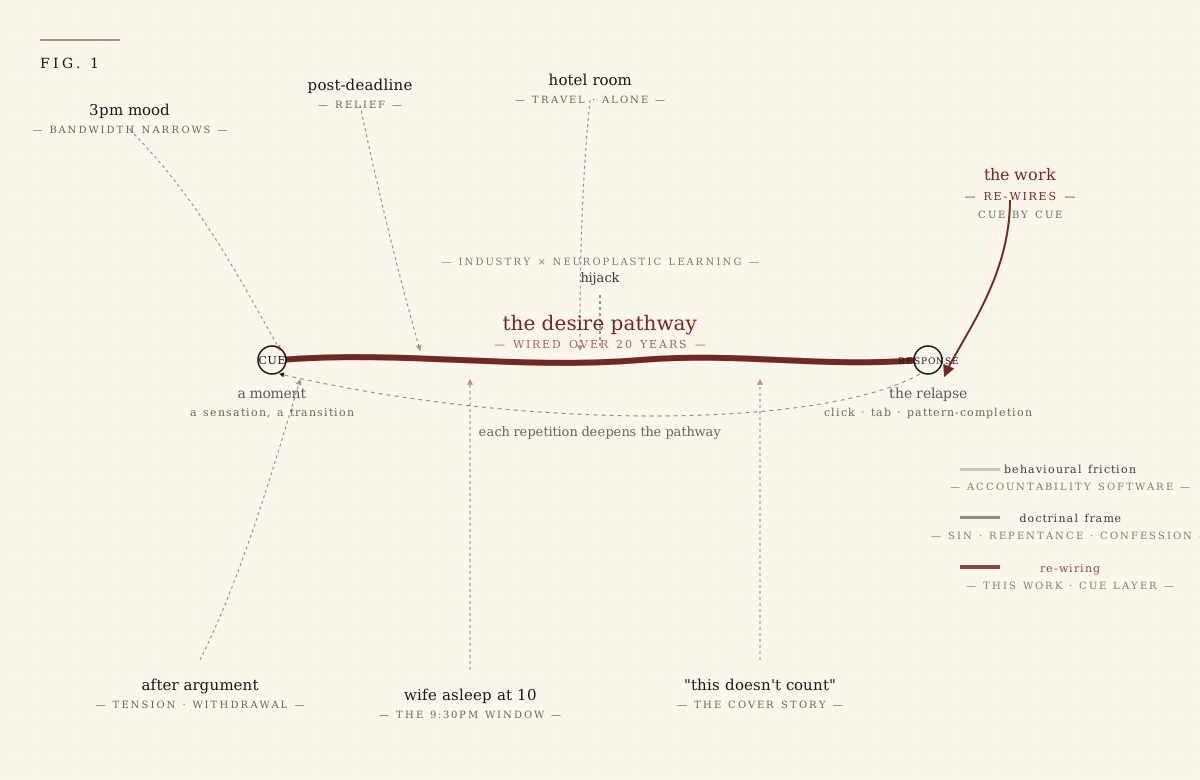
The pathway is not the behaviour. The behaviour — the click, the tab opened, the relapse — is the visible end of something that has been firing for a long time before the hand reaches for the device. In a brain that has been exposed to pornography over decades, the part of the system that learned to pair specific cues with the response has been trained, thousands of times, to pre-empt the conscious decision. A mood drops at three in the afternoon and the pathway fires before the thought I want this has finished forming. The deadline closes at five and the pathway fires. The wife goes to bed at ten and the pathway fires. The lonely hotel room fires. The argument with her on Tuesday fires. The good day with her on Wednesday fires too, because by now the pathway has learned to fire on relief just as readily as on stress.1 What the literature calls cue-reactivity is the technical name for the layer where the desire actually lives — and it is wired below the layer of belief. The pathway does not require permission in order to fire. It does not require theology in order to fire. It does not even require desire in the conscious sense. The pathway is the desire, generating it from a set of cues the brain learned to associate with relief over twenty years of repetition.

That layer is what hijacked names. The agent is outside — the industry's deliberate engineering of the response, multiplied by the brain's neuroplastic willingness to learn anything that is repeated often enough. The agent worked. The pathway is wired. None of that erases personal responsibility — the man inside the pattern engaged with the hijacker, repeatedly, and that is its own conversation. But the hijack is also real. There is a layer below the moral layer, and the layer below is where the firing happens.

Editorial illustration of the desire-pathway / hijack / re-wiring loop. The cue (a moment, a sensation, a transition between activities) fires; the pathway, wired by twenty years of repetition, delivers the response; the response confirms the pathway's expectation and deepens the loop the next time the cue arrives. Behavioural friction acts on the response. Doctrinal frame acts on the meaning. Re-wiring works one layer below — at the cue itself, where the firing is generated.
Figure 1 The desire-pathway / hijack / re-wiring loop. The cue (a moment, a sensation, a transition between activities) fires; the pathway has been wired by repetition to deliver the response; the response confirms the pathway's expectation and deepens the pattern the next time the cue arrives. Behavioural friction (accountability software) acts on the response. Doctrinal frame (sin and repentance) acts on the meaning of the response. Re-wiring works one layer below — at the cue itself, where the firing is generated.

Three things follow.

The first is that the existing Christian recovery ecosystem is not wrong; it is one layer above where the work has to happen.

Pure Life Ministries teaches biblical doctrine. Its frame is sin, repentance, the heart of the matter. For some men, the doctrine was the gap — they had not understood what their behaviour meant theologically — and Pure Life closes it. The men who arrive on this page have done Pure Life. They closed the doctrinal gap. The pathway is still firing.

Conquer Series installs the rewiring frame correctly. Porn rewires the brain, but Christ can rewire it back — the slogan gets the science right, and the men who arrive here own the language. What Conquer Series does not deliver is the protocol that re-wires the pathway from the inside. It teaches the concept; it leaves the man to find the mechanism elsewhere.

The Freedom Fight runs an eight-week structured program with the strongest group-intensive scaffolding in the space. Same gap. The program is delivered. The pathway-mechanism is not.

Covenant Eyes — and Accountable2You and Bark and Ever Accountable and the rest of that family — is behavioural friction, not recovery. It is the infrastructure of Christian recovery, not the recovery. The accountability software is what the work is supposed to scaffold toward. Many of the men reading this have spent a thousand dollars over four years on the software, and the pathway is unchanged.

Faithful Counseling — and Christian counselling generally — is licensed Christian talk-therapy at affordable price points. It is a neighbour to this work, not a competitor. Many of the men who arrive here have done six or twelve months of Christian counselling and hit the talk-therapy ceiling: insight without the pathway-level shift. There is a place this work begins where Christian counselling reaches its end.

Celebrate Recovery offers the steps and the community at the scale of thirty-five thousand churches. For some men, the community is what they needed and could not find anywhere else. For most of the men reading this, the public-confession format is the wrong shape. He went once. His brother-in-law's small group was at the next table. He has not been back.

Begin Again Institute does the fourteen-day Christian intensive in Colorado at five thousand dollars and up. It is the strongest depth-of-work in the Christian recovery space. It is also two weeks away from the family, two weeks of explanation to the elders or the employer, and a price band that puts it out of reach for most of the men who would benefit from it.

None of those programs is wrong. Each does something real. None of them is doing the work one layer below — at the pathway itself, at the place where the trigger is generated, in the part of the brain that has learned to fire on cues over decades and has been rewarded for the firing thousands of times. That is the layer this work addresses, and that is the one piece of the stack the existing ecosystem leaves out.

The second thing is the medication question — and it deserves naming here, briefly. Some men reading this are on SSRIs for depression or anxiety adjacent to the struggle, or for OCD-spectrum compulsivity. Some are on naltrexone off-label. The work is not in competition with medication. Faith does not exempt the body from medication; medication does not exempt the body from learned pathways. The pathway is the pathway either way.

The third is the layer the work actually targets. In a calm, focused state — the same calm, narrow attention a man has been in while reading a Psalm slowly or holding a long silence after Communion — the part of the brain that learned the cue is spoken to, and helped to learn something different. Cue by cue. The three-in-the-afternoon mood, the post-deadline relief, the lonely hotel room, the argument-with-her cue, the good-day-with-her cue, the wife-asleep-at-ten cue. Each one mapped, each one re-wired, across more than one session.2 Romans 12:2 names what the Christian life keeps asking of us — be transformed by the renewing of your mind — and the pathway-level work is the same renewing, done on the specific layer where the desire is generated. The cue does not require belief in order to fire. Once the cue is re-wired, it does not require belief in order to settle.

A morning that does not begin with the apology-prayer.

When the desire pathway settles

It is a Tuesday in the middle of the year. He wakes. He reads the passage on his phone — the way a person reads a passage, not as a small private penance for last night. The first sentence of his day is whatever is actually in the text. The apology has not been the first sentence of the day for some weeks now, and he has stopped noticing the absence the way he had noticed the presence.

A Sunday afternoon, autumn, the children at his sister's. The house is quiet in the particular way it is quiet when no one is watching. He puts his hand on the back of his wife's neck the way he did before any of this, before he had a hard drive, before he had a private list of what was confessable and what was not. She turns toward him. She does not flinch toward the question she has stopped asking. The room is quiet. Later, in bed, with her asleep on his chest, his hand is in her hair. He does not think about it until the next morning, on the drive to work, when it occurs to him that he has not done that — that small unguarded thing, his hand in her hair while she sleeps — for years. He has not been capable of it. He had not known he was not capable of it until it returned.

A Sunday morning, communion. The bread comes around. The cup comes around. He lifts the cup, and his hand is steady. He is not rehearsing what he will say to her in the car about a headache he does not have. He drinks. He sits down. The service continues. He hears it.

This is not the absence of having ever struggled. The twenty years are the twenty years. It is the absence of the apology as the day's opening sentence. The absence of the inventory taken every morning of what last night was and whether she will ask. The absence, on the drive home from the deacon meeting, of the question that would not let him sleep. The version of himself he had begun to mourn, in his own kitchen, in the dark, without saying the word — returning.

What makes the difference between that morning and this one is concrete. It is seven sessions long.

The seven sessions

These sessions are usually online, by video — once a week, about an hour each. You sit at home, comfortable and in control. There is no waiting room and no commute, which some people find helpful on hard days.

The first session is mostly listening. I take a careful history — when the pattern started, how it has shaped, what programs you have already worked, what stopped working and why, what the marriage is carrying right now, whether PIED is in the picture. I do this without flinching and without the just be a man register, because that register is the reason you are here and not in a men's group. The history matters because the cues this has been firing on are specific to your life, and the work in the next sessions is calibrated to your cues, not to a generic man's. We measure a baseline at session one — the cue-profile, the firing pattern across a typical week — so we have something to compare against later. Then I guide you for the first time into the focused, relaxed state hypnotherapy uses. People sometimes expect to be unconscious, or unable to remember what was said; that doesn't need to happen. You're almost always awake, you hear me, and you can reject anything I say at any point. Hypnotherapy is similar to the state of being engrossed in a story — a focused, narrow attention, calm and centered.

The middle sessions are normally where we work at the core of the issue. We work with the layer that learned the pattern — and we work on breaking those patterns. Sometimes the root is a specific event. Sometimes it is a long pattern of small ones. Sometimes it is a relational early-life the client has been carrying unknowing since they were young. The cues this has been firing on are mapped one at a time — the three-in-the-afternoon mood, the post-deadline relief, the lonely hotel room, the after-argument moment, the wife-asleep-at-ten window, the this-doesn't-count moment that has been used as cover for years. In Christian hypnotherapy you do not relive that. We deal with those issues in safe, structured, supported ways, to let those old patterns settle into new instructions. Between sessions you have an audio recording — I make it for you — that you'll listen to most days. Some clients begin to notice shifts by the second or third session. Some take longer. Hypnotherapy compounds — not only at each session but even in the time between sessions. The subconscious is always processing — always growing.

Around the middle of the work we field-test what has changed in actual life — a Wednesday afternoon that did not narrow, a Friday night that closed the laptop without the inventory of options the behaviour used to run — and what surfaces is brought back into the room. The cues that fire most often have usually started to settle by now; the ones that fire less often come up and are worked too. Where this and the marriage meet, we work the meeting — not as marriage counselling, which is its own discipline, but on the specific intersection. PIED, where it is in play, is on the table here as well. The literature suggests PIED is often a downstream consequence of the same hijack, and the re-wiring often moves the PIED, partially or fully, over the package. The page does not promise this for any individual man.

The closing session is integration. We review what has settled, what has shifted, and what to do if the pattern tries to fire again later — we talk about how to respond so you are confident about what to do after the sessions.

Some of the men I see respond fully — the pathway settles, the marriage begins to thaw, communion returns. Some respond partially — the pathway loses most of its frequency and is at a fraction of what it was. A minority do not respond. I cannot promise you which side of that you will fall on, and I will not pretend otherwise. The discovery call exists in part to assess fit before you commit to the seven. For severe-end presentations specifically — material that has crossed into legal-trouble territory, illegal content, behaviour that has crossed into harm to others — the call exists in part to route appropriately, not to take the booking. I will tell you so honestly, and I will tell you where the right next step is.

A note from the practitioner

I am a Christian, and I work as a clinical hypnotherapist. Yes, Christian hypnotherapy is not just possible — it has proved to be good and helpful to many fellow Christians over the years.

If your faith is part of how you carry your life, you may be wondering whether Christian Hypnotherapy belongs in the same room as your prayers. The short answer is yes. The longer answer is in the Christian Hypnotherapy Guide, which I would encourage you to read if you would like more depth. In summary: the focused state we use in a session is not a spiritual state. It is the same calm, narrow attention you have probably been in while reading a good book, watching a good movie, or contemplating a Psalm. Romans 12:2 asks us to — be transformed by the renewing of your mind. The mind has layers. Thoughts and talk reach the surface. The deeper layers respond to medication — and hypnotherapy. And unlike medication, hypnotherapy has no side effects to worry about. Just the ability to use your brain to its best natural capacity.

The men I see have done more than people give them credit for. They have read their Bibles for thirty years. They have memorised John Owen on mortification of sin. They have done Pure Life — sometimes twice — and Conquer Series and the Friday-morning men's group. They have installed Covenant Eyes and they have found the workaround, and the workaround has cost them more than the software ever cost in dollars. They have prayed help me to hate this sin almost nightly. And somewhere along the way, after the third or fourth or eleventh failed program, they have begun to wonder whether the prayer was being heard at all. The prayer is the right prayer. The prayer has not yet been answered in the form you asked for it. The Hosea pattern — God buying his bride back, again and again — is the typology your tradition has been carrying for this. Bring you back is what He has been saying. Hypnotherapy is one of the shapes that brings you back. Not the only shape. One of them.

A short note on medication. Some of the men reading this are on SSRIs for depression or anxiety adjacent to the struggle, or for OCD-spectrum compulsivity. Some are on naltrexone off-label. Hypnotherapy is not in competition with medication. The pathway is the pathway either way. Many clients eventually reduce medication under their doctor's care; many do not. There is no shame in either direction.

(If you are not a Christian you are welcome as well. Hypnotherapy still works. I am trained, skilled, and I deliver results.)

I have watched this pattern run the same way in faithful men — for years. The pattern is not a failure of faith. It lives in the layer below your thoughts. That is what hypnotherapy reaches. And that's what we can use to bring about real change together.

— Charles

Read the full Christian Hypnotherapy Guide →
Charles Lobo

Charles Lobo

Clinical Hypnotherapist · Diploma, Australian Academy of Hypnosis · Member, ASCH

“It never felt like just a technique — it felt spiritually grounded. The sessions helped me begin releasing trauma in a way that felt safe, guided, and meaningful.” — Mya EdwardsChrist-centred sessions · verified Google review

Frequently asked questions

I have done Pure Life. I have done Conquer Series. I have read The Freedom Fight. How is this different?

Each of those programs is doing real work, and I have to acknowledge that before I describe the difference, because the men I see have done one or more of them and the gap is not in the programs' integrity. Pure Life teaches biblical doctrine well — for some men, the doctrinal frame was the bottleneck, and Pure Life closes it. Conquer Series installs the rewiring concept correctly — the brain does re-wire, and that is true. The Freedom Fight runs the eight-week structure, and the structure helps. The men who arrive in my work have closed the doctrinal gap, own the rewiring frame, and have done eight weeks of structure — and the pathway is still firing. That is the gap. The work I do begins one layer below all three: at the desire pathway itself, in the focused state where the cue can be spoken to. It does not replace what the programs have given you. It addresses the layer the programs are designed to scaffold toward.

My wife found out and the marriage is on the brink. Can hypnotherapy move fast enough?

Honest answer. Some of the marriage's stabilisation begins in the first three sessions, because the pathway's frequency starts to drop and your wife notices, often before you do. The deeper marriage work — the trust she has lost, the year of silence around bedtime, the betrayal carried in her body — is its own discipline, and I am not a marriage counsellor. What I can tell you is that men whose marriages have been in this state often find that the pathway-level work is the floor the marriage couldn't be rebuilt on while the floor was still moving. Once the floor settles, the marriage work has somewhere to stand. If the marriage needs urgent professional support alongside this — and many do — I will say so on the call.

I'm Christian and I'm not sure hypnotherapy is allowed for me.

That is a reasonable question, seriously, and you can find an in-depth answer in the Christian Hypnotherapy Guide. The short version: the focused mental state we use in a session is not a spiritual state. It is the same calm, narrow attention you have experienced when engrossed in a good book, or a good story, or in contemplation — you are still awake, aware, your own master. Hypnotherapy works on the physical body and mind, not on the spirit. You remain in control. You can reject anything I say. There is no surrender of will. Hypnotherapy is safe, effective, and powerful.

Will you talk to my pastor or my accountability partner?

Yes — within the limits of clinical confidentiality. If your pastor, your elders, or your existing accountability partner would benefit from a conversation with me before you book, that conversation can happen, and I am willing to speak directly with pastors who want to validate the work for their own people. The conversation will be about the work, not about what you have shared with me; what you tell me in a session stays between us unless you choose to bring it elsewhere. Many men find that bringing their pastor into the loop — without the clinical detail — is what makes the work integrate cleanly with the rest of their Christian life rather than running parallel to it.

What about my SSRI or antidepressant?

Hypnotherapy is not in competition with medication. They are different mechanisms — SSRIs regulate neurotransmitters; hypnotherapy retrains the pattern itself. Many of my clients are on or have been on an SSRI when they begin, and the sessions proceed without difficulty. Some clients eventually reduce or come off medication under their doctor's care, as the underlying pattern shifts and the medication is no longer necessary. Always coordinate medication changes with your prescribing doctor.

What if it doesn't work?

Most of my clients respond fully. A few respond partially. A minority do not respond. In the discovery call we can assess your fit. If by the middle of the package you are not responding, we will have a conversation about whether to continue or to refer you elsewhere — for a different modality. You will be refunded for the remaining sessions. But it rarely happens. If you are willing and sincere, Christian Hypnotherapy has a great chance of working for you.

One frank line this category specifically requires: severe-end presentations — material that has crossed into legal-trouble territory, illegal content, behaviour that has crossed into harm to others, or court-ordered therapy contexts — are out of scope for this protocol. The discovery call exists in part to assess that. If a different kind of help is what you need, I will tell you, and I will tell you where to find it.

What clients say

★★★★★

“As a Christian I didn’t believe in hypnosis. But what Charles does is not like magic or evil — it is simply resetting your brain to its original functions. I am 65 and struggled for years. Now I am happy and dealing with life in the Christian manner.”

Lacinda E. Long-term struggles · skeptic turned believer
★★★★★

“What drew me was that he was a Christian and his coaching would reflect this. He is a great mentor. My son is calmer. He seems more mature. This was a huge factor for working with Charles.”

Joyce G. Parent · teen son
★★★★★

“Charles did fantastic work with me on my anxiety issues that were stemming from work. He really knows this healing modality very well. Hypnosis works. Hypnosis works when Charles does it!”

Anthony B. Work anxiety · resolved

Twenty minutes, on video.

We will talk about the shape of what you are carrying — when this started, how it has shaped, which programs you have already worked, which cues you have noticed firing hardest, what is happening in the marriage, whether PIED is in the picture, where you are tonight. You can ask me whatever you need or want to know. At the end the call you will be confident either yes — this is the right next step for you. Or no — this is not the right next step, and here is what else might be, whether that is a referral, a different modality, or a question worth taking back to your GP or your Christian counsellor. For some men the right next step is Begin Again's intensive, an addiction-medicine specialist, or a Christian psychiatrist. For severe-end presentations specifically — material that has crossed into legal-trouble territory, illegal content, behaviour that has crossed into harm to others, court-ordered therapy contexts — this package is not the right next step, and I will tell you so directly and route you to the kind of help that is. I do not take bookings that should not be taken.

It is not a sales pitch, not a session in disguise, not a hypnosis demonstration, not a confession session. The honest discussion is the reason this call is so helpful for you and for me — is this the right next step for you — answered together.

Start Here

A private Christian hypnotherapy consultation with Charles. Twenty minutes by phone or video. AU$25 credit to your first session.

The desire pathway can be re-wired.
The next step is a 20-minute conversation.

You have carried this for long enough to know what it costs you. Another year of it will cost more of the same. Twenty minutes of conversation costs almost nothing — and at the end of those twenty minutes you will know whether this is your next step, or it isn't. Let's talk.

Start Here

A private Christian hypnotherapy consultation with Charles. Twenty minutes by phone or video. AU$25 credit to your first session.