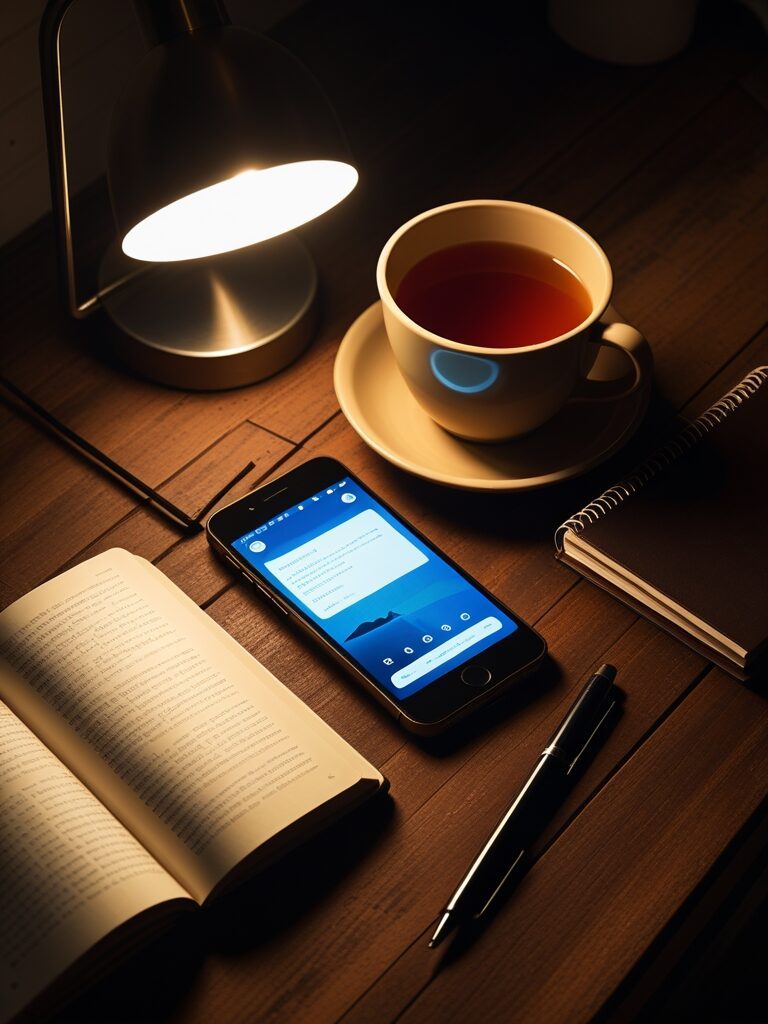
11:47pm. Your thumb is already moving.

Your discipline isn't broken.

You said you'd finish the assignment tonight. You said you'd read the chapter. You said you'd put the phone down by ten. Then your hand reached for it anyway, and now it's almost midnight, and tomorrow is going to cost you.

This isn't a discipline problem the way it looks. The part of you that picks up the phone in the dark moves faster than the part of you that decides. You can train it. With Christian hypnotherapy for self-discipline your hand learns to pause before it opens the app, the assignment gets a real run, and the chapter gets read. Your faith is part of it. You stay awake, you can speak, and you decide what we work on.

You may have already tried things. The blockers. The YouVersion plan. The habit book. The accountability partner. But they are hard to do and hard to keep doing. Hypnotherapy is different.

Start Here
A late-evening still-life on a kitchen table: a phone face-up with a feed glowing in the dark, an unread paperback closed beside it, a half-finished cup of tea, an open notebook with a single pen across it — the 11:47pm moment after the day has gotten away.

The thing you keep meaning to do

You close the laptop after dinner because you are done for the night. Then you open it to watch just one episode. One episode sounds reasonable. Then the episode ends and you get up. Soon the kitchen is half-clean, but you take the phone for ten minutes because ten minutes sounds harmless. Before you know it, the clock says 11:47pm, the phone is still warm in your hand, your neck is stiff, and the thought is sitting there half-formed: I cannot keep doing this.

You've installed Opal twice. You've set Cold Turkey, then found the workaround by Thursday. You've grown a Forest tree, killed the Forest tree, and felt ridiculous for caring about a cartoon tree. You've turned on Apple Screen Time, ignored the gray hourglass, and typed the passcode you swore you would forget. You've bought the lockbox, put the phone in the lockbox, and then kept the lockbox key in a place close enough to reach. You've read Atomic Habits and underlined the part about making habits obvious. You've opened Cal Newport and agreed with every page about deep work while the chapter you need for school is still on chapter 2. You've read John Mark Comer on hurry, nodded hard, and then checked Instagram before the kettle boiled. You've asked for an accountability partner. You've tried Pomodoro. You've made the list, bought the planner, renamed the Notion page, cleared the desk, and promised Monday would be different. The Etsy shop is still half-built. The photo book is still half-edited. The application is still waiting. The chapter is still on chapter 2.

Your partner asks, “Are you listening?” and you were, mostly, until the phone lit up. Your kid asks why you're always on your phone. Your mother's voicemail sits there because calling back feels like one more thing you already failed to do.

Underneath, there's a sentence you don't say aloud: I am the kind of person who keeps starting things and not finishing them.

No one has special willpower. Your willpower works. It just can't reach the moment before your hand moves.

If you can relate to some of these scenes, you already see what's happening: it's a learned pattern, not a character problem. You can retrain a pattern like that.

You aren't lazy.

You aren't lazy. You work. You show up. You make the lunches, hit the deadlines, keep the family running. For many of us, the discipline is still there when somebody else needs us; the discipline gets thin when our own need is the one on the calendar.

From the outside, the phone in your hand can look like a simple discipline failure. But I've sat across from a lot of people who tell me the same story. From the inside, your hand can move before a full thought even forms. Your hand goes to the phone before you have decided anything. The morning is half-over before you notice it started. What looks like character from outside feels like reflex from inside.

The effort you have made counts. I know it does. The Opal install, the YouVersion plan, the Lent fast, the accountability partner — those were real efforts aimed at real problems. They have not made inroads because they have been working on the part of you that thinks it through, not the part of you that's already reaching for the phone.

Willpower helps when the choice is already in front of you. Your hand starts moving earlier, before the choice arrives.

Here is what is actually happening — and why willpower keeps missing the moment before your hand moves.

What's actually happening

Hypnotherapy for self-discipline works on the cue-craving-reach loop underneath conscious choice. Boredom, discomfort, or a pause cues the body; craving asks for relief; the hand goes to the phone. In a focused state, hypnotherapy retrains the subconscious before your hand follows the old route. For Christian clients, Scripture and prayer can anchor the new response. Most clients see the change they came for in five sessions or fewer.

You know the moment.

The cursor blinks in the document. The paragraph looks harder than you wanted. Your hand moves toward the phone before you have made a clean decision. A browser tab opens while the assignment, chapter, invoice, or project sits there unfinished.

That hand movement matters.

Your thinking mind makes plans. Your thinking mind reasons, promises, reads the habit book, sets the blocker, and says, “Tomorrow I'm starting properly.”

There's a quieter part underneath that moves the hand first. It opens the app, avoids the blank page, follows the learned cue, and takes the quick way out before the promise catches up. Clinicians call it the subconscious.

Plain version:

  • Cue: boredom, a pause between tasks, a blank document, 11pm quiet, a hard paragraph.
  • Craving: your body wants relief, novelty, escape, or the quick hit.
  • Reach: phone, browser tab, Pinterest, email, next video, another planning tool, anything away from the task you meant to do.

I help you get closer to that reach point. In a hypnotherapy session, you stay awake and in control. In a focused state, we rehearse a different response right where the cue usually grabs you.

Willpower / habit-stacking / habit books.

Willpower helps. Structure helps. Cue removal helps. Atomic Habits has helped plenty of people build better days, and I'm not here to take a swing at useful advice.

Here's the rub. Conscious plans often arrive late.

You can have a beautiful morning routine, a new notebook, and a plan written in blue ink. Then the blank page shows up, discomfort hits, and your hand has already moved. The plan was honest. The reach was faster.

With willpower hypnotherapy, I target the faster learned response underneath the plan. Your thinking mind still matters. Your calendar still matters. But your hand needs a new route when boredom or discomfort shows up.

The apps.

Opal, Forest, Cold Turkey, Screen Time, Apple Downtime, and lockboxes can all add friction. Friction can buy you time. Sometimes friction is exactly what a person needs.

But craving sits in the middle of the loop. Craving can get creative.

Instagram is locked, so Pinterest opens. The phone is blocked, so the browser version opens. Your personal laptop is restricted, so the work laptop becomes the escape hatch. The phone is a useful tool caught inside a trained loop, and the trained loop keeps looking for a door.

I don't demonize the phone. I help you stop using the phone as the default reach every time your body wants out.

“Pray more.” “Fast from your phone.” “Depend on the Holy Spirit.”

Some of you have prayed about this for years. You have fasted. You have started YouVersion plans. You have asked the Holy Spirit for help, meant every word, and tried again the next morning.

Prayer is real.

Clinical hypnotherapy gives you another way to address the same learned reach. Therapy and prayer aren't in competition. For Christian clients, I can use Scripture and prayer to anchor the new response. Romans 12:2 gives Christians familiar language for renewing the mind, and I take that seriously without turning your session into a sermon.

Doomscrolling, the smoke-reach, the drink-reach, the next-tab reach — same shape underneath. Different content, same learned move. I use the same pattern in addiction work, because the hand-to-phone reach and the hand-to-cigarette reach are cousins.

Feeds keep the reach sticky because variable reward design gives you sometimes a rewarding post, sometimes nothing, and sometimes the one post that lands.

Most clients see the change they came for in five sessions or fewer.

I've seen people move faster when we stop scolding the plan and start retraining the reach.

The same pattern runs the scroll. Now to the scroll specifically.

The doomscroll, specifically.

The screen has hypnotised you. Time disappears, your attention tightens, and your thumb keeps moving before your better judgment gets a vote.

Most of us know that chair. It's between 11 p.m. and 1 a.m. The day is over. The decisions are made. Willpower is thin. The book you meant to read is sitting right there on the table. The phone is closer. The first Reel looks innocent. By the fourteenth, you've stopped trying to put it down. And tomorrow morning, you'll pay for it.

Then there's the content itself. Bad news, strangers' disasters, the latest atrocity, one after another. Your body tightens. The stress is real. Then you scroll to feel less stressed — but it's the scroll that's stressing you. Same thumb. Same scroll. Both jobs.

We can interrupt this. In hypnotherapy — with prayer and Scripture woven through — your hand learns to stop before the app opens. Doomscrolling hypnotherapy at The Christian Hypnotherapist works on that moment. The feed keeps you scrolling because you get sometimes a rewarding post, sometimes nothing, sometimes the one that lands. In a focused state, your hand learns a new response at the cue. For Christian clients, prayer and Scripture anchor the redirect. Most clients see the change they came for in five sessions.

“Like a city whose walls are broken through is a person who lacks self-control.” — Proverbs 25:28, NIV

Solomon gives the diagnosis. When self-control breaks, the walls are open. You can see it at 11:17 p.m., in the unread chapter, in the phone in your hand again. Willpower keeps patching the top of the wall. Hypnotherapy works lower — where the wall first broke.

Scripture also gives the prescription for attention: “whatever is true, whatever is noble, whatever is right, whatever is pure, whatever is lovely, whatever is admirable — think about such things” (Philippians 4:8). Doomscrolling is, at minimum, attention pointed in the wrong direction. In session, you rehearse turning your attention back to those things at the moment your hand would normally open the app.

The same pattern lives in the addiction work — the smoke-reach, the drink-reach, the next-tab reach. Different content. Same learned reach.

Now, the phone isn't evil. You use it for the Bible app, family texts, and GPS to soccer practice. What changes is the pattern, not the phone — so the phone becomes a tool again, not a temptation.

For the Christian reader wondering whether hypnosis belongs in Christian care: that question comes next.

Is hypnotherapy good for Christians struggling with this?

The short answer is yes.

If your hand is on your phone at 11:17 p.m. after you prayed for self-control at 10:00, or your Bible plan and unfinished assignment haven't been followed again, you are not dealing with a small annoyance but a broader issue.

Christian hypnotherapy for self-discipline can be a good fit for Christians when a Christian practitioner uses hypnosis clinically. Scripture does not talk about doomscrolling, but we know how important our attention, desire, and obedience are. Philippians 4:8 calls us to dwell on what is true, noble, right, pure, lovely, admirable. At The Christian Hypnotherapist, I help retrain your automatic reach-for-the-phone pattern that is living beneath your conscious choices, so your desire and your habits start working in the same direction.

You may have prayed about the phone. You may have deleted apps, made promises, restarted the YouVersion plan, bought the notebook, set the timer, — and still ended up back in the same chair with the same sinking feeling.

Then, for many of us, shame joins the party.

Now you are not just tired. You are wondering whether your lack of discipline says something bad about you. You are wondering whether asking for clinical help means prayer failed, or whether your brain is broken, or whether you are just lazy. These questions do not make you weak. These questions mean you have been dealing with the problem alone for too long.

Regarding hypnotherapy, good people have already done some of the heavy lifting. Focus on the Family treats clinical hypnosis as acceptable for Christians when used wisely. The Catholic Church has weighed in too; Pope Pius XII spoke of therapeutic hypnosis as legitimate when used ethically. From the secular, medical, side the American Medical Association has recognised hypnosis as a useful and valid medical modality back in 1958.

The Gospel Coalition and Desiring God have also taken phone addiction seriously, and I think they are right to take attention seriously. If your thumb opens the feed before your mind has made a real decision, the devotional writers and the clinical pattern are pointing at the same thing from two angles. You are losing attention. You are losing time. You are losing the quiet place where obedience usually starts.

“For the Spirit God gave us does not make us timid, but gives us power, love, and self-discipline.” — 2 Timothy 1:7, NIV

The gift comes before the grit: sophronismos, the word translated “self-discipline,” means a sound, settled mind, not gritted teeth. You need that gift in the half-second before your hand opens the phone, before the chapter goes unread, before the assignment gets avoided; you receive the gift from God, and in session I help your body and mind cooperate with the gift.

I work as a Christian practitioner. Scripture, prayer, and Christian language are part of how change happens at The Christian Hypnotherapist. You do not have to sit through a secular session, then go home and translate every insight into Christian terms by yourself. I keep one clear frame: your mind, your habits, your body, your conscience, and your life before God belong together.

If you want the longer answer, Is hypnotherapy a sin? Read the full Christian guide.

What a session actually looks like.

You'll know exactly what we're doing, what we're aiming for, and your week will show progress towards it. The pattern you came in for usually starts changing after the very first session. You see the difference in normal life — the phone moment, the snack moment, the late-night moment, the “I'll start tomorrow” moment.

What happens in a session

In a Christian hypnotherapy session with me, we start with: What do you want to change? What have you tried? What worked for three days and then fell apart? What would “better” actually look like by next week?

Then I guide you into a focused state. Most people describe it as calm, clear, and surprisingly normal. Like being deep in prayer. Like getting pulled into a good book and forgetting the noise around you. You hear me. You can speak. You can stop at any time.

Then we work with the cue and the new response. The cue might be 11pm on the couch. The cue might be opening the laptop and suddenly ending up somewhere useless. The cue might be the first uncomfortable feeling after a long day. We rehearse the new response until your mind starts treating it as familiar.

You stay awake and in control the whole time. You can reject anything. Your subconscious knows what's best for you. Your mind practices a better pattern so you can rewrite entrenched habits.

Where a short audio fits your case, I may give you one you can use between sessions.

How faith integrates

Scripture, prayer, and Christian language are part of how the change happens. They line up your mind and body with what you already believe. For many of us, the problem was never a lack of belief. The problem was a trained pattern that kept taking over at the worst time. We may use the language of power, love, and self-discipline from 2 Timothy 1:7, along with your identity in Christ, as part of the session. You get both the clinical method and the Christian fellowship in one session, with one person.

What we can expect

Most clients see the change they came for in five sessions or fewer. A simpler case, like doomscrolling by itself, often lands in 3-5 sessions. A longer-pattern case, especially when anxiety, shame, or years of abandonment are wrapped into the pattern, may take 5-7. We assess progress every week to make sure we're moving forward.

Surface-level fixes ask you to work on yourself every day. Willpower. App blockers. Habit trackers. Another Bible plan you start with good intentions and quietly drop by Wednesday. Most of us have done some version of that. In session, we train your mind to expect a different next step when the old cue shows up. That is why the new pattern can hold on a Sunday evening when you are tired, cranky, and not thinking about self-improvement. It's easier and it works.

I'm Charles Lobo — Clinical Hypnotherapist (Diploma, Australian Academy of Hypnosis; Member, ASCH). Christian practitioner.

More about Charles Lobo — credentials and faith

What we'd do together.

Start with a discovery call

The discovery call is 20 minutes, online. Your AU$25 deposit is refunded the moment we begin. We don't do hypnosis on the call. We map your goals, check fit, plan the work, and answer your questions.

Sessions are live online

Your sessions are live online, weekly, and about one hour. Choose a quiet space, keep your camera on, and use headphones if you can. Sessions go best when you can work without half your house walking past you.

How many sessions?

Most people notice a change after the very first session. If the main problem is doomscrolling on its own, 3-5 sessions is typical; if scrolling is tied to anxiety, exam pressure, or years of feeling like you are just undisciplined, five to seven sessions is the range. We review progress every week. You stop when you've got what you came for.

A defined endpoint

You will have clear goals from the start so we can focus on giving you what you need quickly. If you want a refresher later, or you want help with a new focus, of course you will be welcomed.

Fees

A single session is AU$250. Bundles run from AU$675-1,470, depending on the number of sessions we agree makes sense. If cost is the barrier, tell me before scheduling — I keep a few hardship places each month.

A lot of therapy leaves people paying weekly with no clear finish line. At The Christian Hypnotherapist, we do it differently: you pay for a set number of sessions, you do the work, and then we're done. You stay steady because the pattern is different — not because you keep showing up to talk about the same phone, the same tabs, or the same late-night spiral. When you've got what you came for we stop and you go back to your new and improved life.

Start Here

Common questions

Is doomscrolling a sin?

Doomscrolling isn't named in Scripture. But Scripture is clear about attention — Philippians 4:8 tells us to think on what is true, noble, right, pure, lovely, admirable. Compulsively dwelling on what disturbs us is at minimum a misdirection of attention. Whether that rises to sin is between your conscience and your pastor.

Read the full Christian guide →

Can hypnotherapy really help phone addiction?

Yes. Phone addiction is a learned pattern — a cue hits, your mind expects relief, your hand goes for the phone, and your brain gets a reward. Hypnotherapy rehearses a new response until your brain accepts it, same as the smoke-reach or drink-reach. Most clients see the change they came for in five sessions or fewer. Sessions are online, about one hour, usually weekly.

Does this work for procrastination and study habits too?

Yes. Procrastination, the chapter you can't start, the project that sits half-finished, the document open with nothing on the page — these are the same pattern as the scroll. The cue is different (the document open, the pomodoro timer, the moment between two tasks). The mechanism is the same. Studying and anxiety often compound — the anxiety page is related.

How many sessions to actually break the doomscroll loop?

For doomscrolling alone, plan on 3-5 sessions. When doomscrolling comes with anxiety, sleep trouble, shame, or study avoidance, plan on 5-7. Most clients see the change they came for in five sessions or fewer. We stop when your goal is met.

What's the difference between hypnotherapy and a screen-time app like Opal or Forest?

Opal, Forest, Cold Turkey, and Apple Screen Time can help. They block the cue or add friction. They usually do not address the craving in between. When the craving rises, we usually get around friction: use the work laptop, a different browser, another site. Hypnotherapy works on the craving itself. We retrain the part underneath, so your brain keeps the new response.

Is hypnotherapy OK for Christians?

Yes. Christian hypnotherapy is fine when we do what God wants for your life. Having a Christian hypnotherapist gives you therapy that is faithful and integrates the most important part of our lives instead of leaving it out. This makes change much easier.

Read the full Christian guide →

What clients say

★★★★★

“As a Christian I didn’t believe in hypnosis. But what Charles does is not like magic or evil — it is simply resetting your brain to its original functions. I am 65 and struggled for years. Now I am happy and dealing with life in the Christian manner.”

Lacinda E. Long-term struggles · skeptic turned believer
★★★★★

“What drew me was that he was a Christian and his coaching would reflect this. He is a great mentor. My son is calmer. He seems more mature. This was a huge factor for working with Charles.”

Joyce G. Parent · teen son
★★★★★

“Charles did fantastic work with me on my anxiety issues that were stemming from work. He really knows this healing modality very well. Hypnosis works. Hypnosis works when Charles does it!”

Anthony B. Work anxiety · resolved

Twenty minutes, online.

The discovery call.

Your discipline isn't broken. The pattern can be retrained. The next step is a 20-minute conversation.

The discovery call is online and takes about twenty minutes. We won't do hypnosis on the call. We'll talk about what's going on: the scrolling, the unfinished work, the discipline you'd like, and what else you've already tried. By the end, I'll outline what five sessions would look like for you. There's no commitment. The point is clarity, not pressure. AU$25 is simply to confirm the booking, and I refund the fee the moment we begin.

If cost is the barrier, tell me before scheduling — I keep a few hardship places each month.

Start Here

Twenty minutes, online. You leave with a clear next step. AU$25 to confirm — refunded the moment we begin.

You've been working at the surface.
The pattern can change. Let's talk.

You've lived with this long enough to know what it costs you. Another year costs more of the same. Twenty minutes costs almost nothing — and at the end of it, you'll know whether this is your next step or it isn't.

Start Here