“Dad, I don't want you holding her if you smell of smoke.”

Your willpower isn't broken. I promise.

The reward pattern learned a cue — and the cue can be unlearned.

Three-session online hypnotherapy for smokers who have tried everything — and are tired of being told they just don't want it badly enough.

Charles Lobo — Clinical Hypnotherapist. Diploma, Australian Academy of Hypnosis. Member, Australian Society of Clinical Hypnotherapists. Working in the Cochrane-recognised tradition of smoking-cessation hypnotherapy. Online. Three sessions.

Start Here
A quiet kitchen morning in soft light: a small grandchild's drawing pinned to the fridge, a half-finished cup of tea, a phone face-down on the counter, a window with morning light. No cigarettes in frame.

What He Has Already Tried

The morning starts the same way. The cough first, productive, three or four minutes of it before the kettle. The first cigarette before the coffee, often before anyone else in the house is up. The back step, the carport, the old jacket with the lighter in the pocket. David has been doing it this way for so long that he has stopped noticing he is doing it. About a pack a day. More, once. He quit cutting down years ago because cutting down doesn't work, and there is a private belief, recited after every relapse, that he mostly keeps to himself. I just don't have the willpower.

The line has lived with him a long time. He has said it to his wife, to his GP, to himself. It has hardened into a fact about the kind of man he is.

He has tried more than people give him credit for. The patches that came off the morning he lit one anyway. The Champix course his GP wrote out — and the nausea, and the dreams that came back so vivid he stopped taking it after eight days. The Allen Carr book that made sense from the first chapter, and the cigarette he lit after lunch on the day he finished it. The hypnotherapist he saw four years ago, paid four hundred dollars for the one-session guaranteed quit, and walked out of believing he had been done badly by the man or by himself. His wife has been asking him to stop for fifteen years. The deadline before fifty. The deadline before the wedding. The deadline before the grandchild. The deadlines that have receded, fifth time now.

His daughter called on Tuesday and said the thing about the grandchild. He went out to the carport afterwards and lit one and stood there a long time. That night he Googled.

None of those failed attempts are evidence that his character is weak. None of them. Each one is data — about which cues the habit has wired, about which moments fire it, about what the chemistry alone could not reach. I just don't have the willpower is the sentence the audience says about itself; it is also, almost always, the wrong diagnosis. Genuinely hard work, for the wrong reason.

None of those failed attempts are evidence that his character is weak. Each one is data — about which cues the habit has wired, about which moments fire it.

What smoking is actually doing

Here is what we have learned about smoking in the last twenty years that has not made it onto most cessation pages.

The cigarette is not just chemistry. The chemistry is real — nicotine reaches the brain in seven seconds, releases dopamine, reduces in an hour, the cycle repeats — and most of the cessation industry is built on managing that chemistry. Patches replace the nicotine; gum replaces it slower; Champix occupies the receptors so the cigarette doesn't reward as strongly. All of that is partly true and partly the wrong layer.

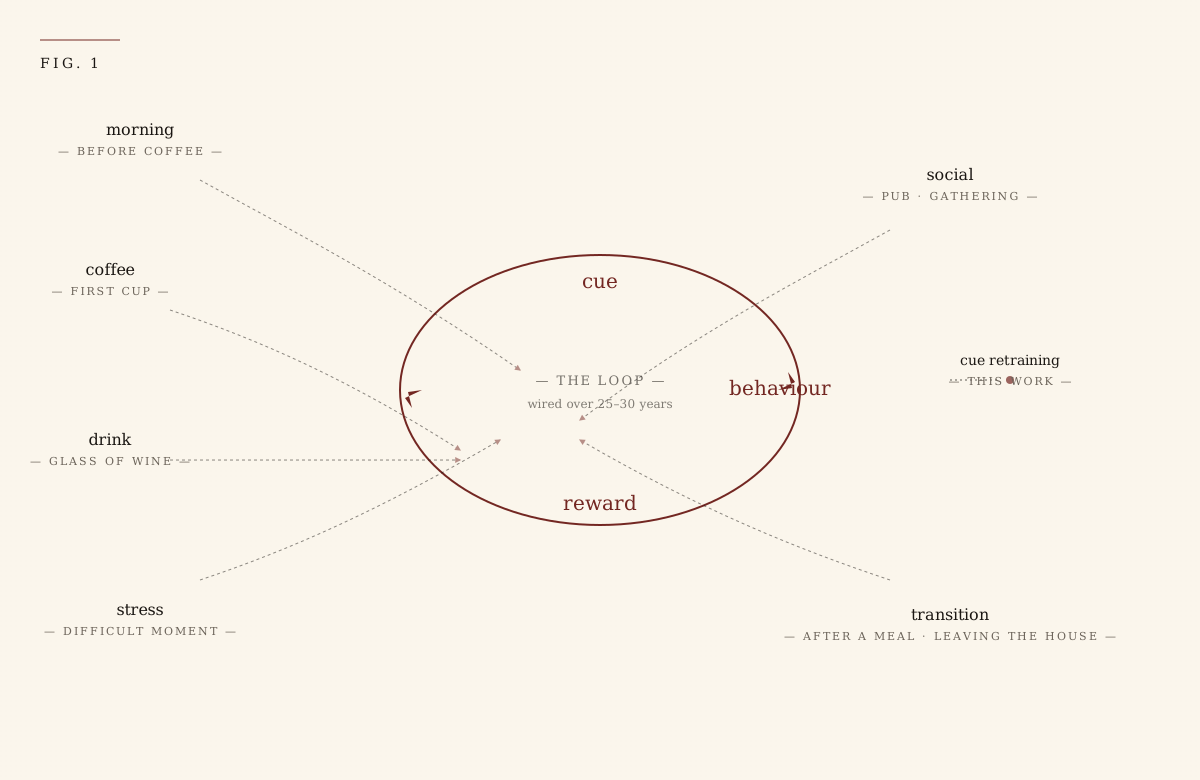
The harder part — the part the chemistry alone cannot explain — is that over twenty-five or thirty years of smoking, the brain wires a habit. Not one habit. Hundreds. Waking is paired with the first cigarette. Coffee is paired with the second. Leaving the house is paired with the third. Then there is the one with the first phone call at work, the one in the car, the one before lunch, the one after, the one when the boss is difficult, the one on the way home, the one with the wine, the one before bed. Each of these is a cue — a specific moment, a specific sensation, a specific transition between activities — and each cue, fired thousands of times, has trained the brain to expect and demand the cigarette. The pattern is cue, behaviour, reward. The cue fires; the hand reaches; the cigarette delivers. This is what makes the urge feel involuntary. It is what makes the hand reach for the pack before the thought I want one has finished. It is also what makes willpower so often the wrong tool.

Editorial illustration of the smoking cue-behaviour-reward loop: morning, coffee, drink, stress, social moment, transition between activities — each cue firing the hand-to-pack response and deepening the loop the next time the cue arrives.
Figure 1 The cue-behaviour-reward loop. The cue (a moment, a sensation, a transition) fires; the behaviour (the hand, the lighter) follows; the reward (the chemistry plus the pattern-completion) deepens the habit the next time the cue arrives. Patches act on the chemistry; willpower acts on the behaviour in the moment; cue-retraining hypnotherapy acts on the cue itself.

Three things follow from that.

The first is that the patches are not wrong; they are partial. The patch lowers the chemistry. It does not retrain the cue. The cue still fires at the morning coffee, and the patch does nothing about the firing. So the smoker sits there with a patch on his shoulder and a hand reaching for the pack, and the hand wins, and the patch comes off.

The second is that Champix is partly right. It dampens the reward. Many smokers get a real result from it before the side effects make the trade unbearable. But Champix does not retrain the cue either. It mutes the song; it does not delete it. When the course finishes, the cue is still there.

The third is the load-bearing one. Allen Carr saw, before most of the cessation field did, that willpower was the wrong frame — and he was right about that. His method asks the reader to see the trick — to recognise that the cigarette never gave what it seemed to be giving. For some, that reframe is enough. For most, the reframe is one step short of retraining the cue. The cue does not require belief in order to fire. The cue is a pattern wired below the level of belief, in the part of the brain that learned to pair waking with smoking thirty years ago and has been firing on schedule ever since. Seeing the trick is real and useful. Retraining the cue is the next step. That is what hypnotherapy is doing, when it is doing it well.

The mechanism is plain enough. In a calm, focused state, you speak to the part of the brain that learned the cue, and you help it learn something different. Cue by cue. The morning, the coffee, the car, the after-meal moment, the wine — each one mapped, each one retrained, across more than one session.1 Which is the place where this protocol diverges from the hypnotherapy David tried before, and from the seminar version of Allen Carr's method. The single-session guaranteed quit treats every smoker's pattern as the same pattern. It is not. The cues that fire for a man waking at 5am for shift work are not the cues that fire for a man whose drinking starts at six in the evening. The protocol here runs across three sessions because the second session calibrates to what the first uncovered, and the third calibrates to what surfaces between two and three. It does not promise an outcome. It retrains the specific cues a particular life has wired.

Hypnotherapy targets the cue, not the chemistry. The morning, the coffee, the car, the after-meal moment, the wine — these are what the protocol retrains. Nicotine withdrawal happens on its own — usually a week or two of feeling rough — and the pattern above it is what changes.

A morning that doesn't start with the lighter.

When the cue releases

It is a Tuesday in the middle of the year. He wakes. The first thing his hand reaches for is the kettle, not the pack. He stands at the kitchen window for a while, holding the cup. The cough is gone, mostly — he noticed it had gone about a fortnight ago, at the eight-week mark, and he is still slightly suspicious that it might come back. It does not.

His granddaughter comes over for the afternoon. He picks her up. The child presses her face into his neck the way small children do, and leans in, and stays there. Her hair smells of baby shampoo. He doesn't think about it until later, when he is loading the dishwasher and he remembers the call from his daughter, the one that started this. He smiles, on his own, in the kitchen.

It is the end of the year. He sits down with a bank statement and does the arithmetic. Fifty dollars a pack times three-hundred-and-sixty-five days, less the eight or so weeks before the hypnotherapy landed. The number surprises him. He thinks about the kitchen. He thinks about the small car the calculator suggests. He doesn't decide anything yet. He just notices.

This is not the absence of having ever smoked. The thirty years are the thirty years. It is the absence of the lighter on the bedside table. The absence of the cough as the morning's metronome. The absence of the calculation, made fifty times a day, of when the next one is and where he will smoke it and whether anyone will mind.

He got back to the life he wanted. Most people can too — see how, next.

The three sessions

These sessions are usually online, by video — once a week, about an hour each. You sit at home, comfortable and in control. There is no waiting room and no commute, which some people find helpful on hard days.

The first session is mostly listening. I take a careful history — when you started, how it has shaped, what you have already tried, what stopped working and why. The history matters because the cues your habit has wired are specific to your life — the morning, the coffee, the car, the after-dinner moment, the work-stress moment, the wine — and the work in the next two sessions is calibrated to your cues, not to a generic smoker's. Then I guide you for the first time into the focused, relaxed state hypnotherapy uses. People sometimes expect to be unconscious, or unable to remember what was said; that doesn't need to happen. You're almost always awake, you hear me, and you can reject anything I say at any point. Hypnotherapy is similar to the state of being engrossed in a story — a focused, narrow attention, calm and centered.

The middle sessions are normally where we work at the core of the issue. We work with the layer that learned the pattern — the part of the brain that paired waking with the cigarette and coffee with the cigarette — and we work on breaking those patterns. Sometimes a cue is tied to one specific moment. Sometimes it is a long pattern of small ones, fired thousands of times. We deal with those cues in safe, structured, supported ways, to let those old patterns settle into new instructions. Between sessions you have an audio recording — I make it for you — that you'll listen to most days. Some clients begin to notice shifts by the second or third session. Some take longer. Hypnotherapy compounds — not only at each session but even in the time between sessions. The subconscious is always processing — always growing.

The closing session is integration. We review what has settled, what has shifted, and what to do if the pattern tries to fire again later — we talk about how to respond so you are confident about what to do after the sessions.

Some of my clients quit at session one and never smoke again. Some quit at session three and stay quit. Some don't fully quit but cut to a fraction of what they were and stay there. A minority don't respond. If by the middle of the package you are not responding, we will have a conversation about whether to continue or to refer you elsewhere. I cannot promise you which side of that you will fall on, and I will not pretend otherwise. The discovery call exists in part to assess whether this is the right next step before you commit to the three.

A note from the practitioner

I am a Christian, and I work as a clinical hypnotherapist. Yes, Christian hypnotherapy is not just possible — it has proved to be good and helpful to many fellow Christians over the years.

If your faith is part of how you carry your life, you may be wondering whether Christian Hypnotherapy belongs in the same room as your prayers. The short answer is yes. The longer answer is in the Christian Hypnotherapy Guide, which I would encourage you to read if you would like more depth. In summary: the focused state we use in a session is not a spiritual state. It is the same calm, narrow attention you have probably been in while reading a good book, watching a good movie, or contemplating a Psalm. Romans 12:2 asks us to — be transformed by the renewing of your mind. The mind has layers. Thoughts and talk reach the surface. The deeper layers respond to medication — and hypnotherapy. And unlike medication, hypnotherapy has no side effects to worry about. Just the ability to use your brain to its best natural capacity.

The smokers I see have tried more than people give them credit for. They have read Allen Carr; they have spent good money on Champix and walked away when the dreams got too vivid; they have been on the patches and off them; they have switched to a vape they now want out of; they have set deadlines for themselves before fiftieth birthdays and grandchildren and family weddings; and somewhere along the way, after the third or fourth or seventh failed attempt, they began to recite the line about willpower as if it were a fact about themselves. It is not a fact about themselves. It is the wrong frame for the actual problem. The cue is the problem, and the cue can be retrained.

(If you are not a Christian you are welcome as well. Hypnotherapy still works. I am trained, skilled, and I deliver results.)

I have watched smoking run the same pattern in faithful men and women — for years. The smoking habit is not a failure of faith. It lives in the layer below your thoughts. That is what hypnotherapy reaches. And that's what we can use to bring about real change together.

— Charles

Read the full Christian Hypnotherapy Guide →
Charles Lobo

Charles Lobo

Clinical Hypnotherapist · Diploma, Australian Academy of Hypnosis · Member, ASCH

Frequently asked questions

I have tried Allen Carr's book — twice. How is this different?

Allen Carr's contribution is real. His central insight — that willpower is the wrong frame for the problem — was a generation ahead of the cessation field, and most of the language about smoking that doesn't moralise comes downstream of him. If you read the book and quit, you don't need me. If you read the book, agreed with every page, and lit one the next day — which is the most common experience the book produces — then the gap is the cue. Carr's method asks you to see the trick. It works for some readers because, for them, seeing is enough. For most, the cue keeps firing whether or not you have seen the trick, because the cue is wired below the level of belief. The work I do begins where Carr ends — at the cue itself, in the focused state where it can be spoken to.

I tried Champix and it made me crazy. The dreams were unbelievable. Will hypnotherapy do that?

No. The Champix experience you are describing is well-documented; nausea in roughly a third of users, vivid nightmares in roughly an eighth, low mood often enough that the package insert names it. Hypnotherapy does not have those side effects, because it is not a pharmacological intervention. The state is calm and awake. You can stop at any moment; you can reject any suggestion. The most common after-effect of a session is feeling unusually rested, the way you might after a deep nap. If anything else comes up — discomfort, intrusive thoughts, anything that doesn't feel right — you tell me, and we adjust the work or stop.

I quit cigarettes by switching to vaping, and now I want out of vaping. Can you help with that?

Yes — it is the same mechanism, often a shorter protocol, and the cue-retraining work is the same shape. There is a separate page on this — vaping hypnotherapy — that goes through the specifics. The short version: vaping has wired its own cues, distinct from cigarette cues; the protocol is calibrated to those.

I'm Christian. Is hypnotherapy okay for me?

That is a reasonable question, seriously, and you can find an in-depth answer in the Christian Hypnotherapy Guide. The short version: the focused mental state we use in a session is not a spiritual state. It is the same calm, narrow attention you have experienced when engrossed in a good book, or a good story, or in contemplation — you are still awake, aware, your own master. Hypnotherapy works on the physical body, not on the spirit. You remain in control. You can reject anything I say. There is no surrender of will. Hypnotherapy is safe, effective, and powerful.

I had one hypnotherapy session before, four years ago. It didn't work. What's different here?

The single-session "guaranteed quit" model is the industry default, and for a non-trivial fraction of clients it overpromises. Some smokers do quit in one session and never smoke again — that is real. Most do not. The work I do is multi-session, relational, and adapts session to session — the second session is calibrated to what we learn in the first; the third is calibrated to what surfaces between two and three. If your prior experience was the one-shot version and it didn't take, that is not necessarily a verdict on hypnotherapy generally. It may be a verdict on the protocol that was used.

What if it doesn't work?

Most of my clients respond fully. A few respond partially. A minority do not respond. In the discovery call we can assess your fit. If by the middle of the package you are not responding, we will have a conversation about whether to continue or to refer you elsewhere — for a different modality. You will be refunded for the remaining sessions. But it rarely happens. If you are willing and sincere, Christian Hypnotherapy has a great chance of working for you.

What clients say

★★★★★

“As a Christian I didn’t believe in hypnosis. But what Charles does is not like magic or evil — it is simply resetting your brain to its original functions. I am 65 and struggled for years. Now I am happy and dealing with life in the Christian manner.”

Lacinda E. Long-term struggles · skeptic turned believer
★★★★★

“What drew me was that he was a Christian and his coaching would reflect this. He is a great mentor. My son is calmer. He seems more mature. This was a huge factor for working with Charles.”

Joyce G. Parent · teen son
★★★★★

“Charles did fantastic work with me on my anxiety issues that were stemming from work. He really knows this healing modality very well. Hypnosis works. Hypnosis works when Charles does it!”

Anthony B. Work anxiety · resolved

Twenty minutes, on video.

We will talk about the shape of your smoking — when you started, where you are now, what you have already tried, which cues you have noticed firing hardest. You can ask me whatever you need or want to know. At the end the call you will be confident either yes — this is the right next step for you. Or no — this is not the right next step, and here is what else might be, whether that is a referral, a different modality, or a question worth taking back to your GP or your Christian counsellor.

The honest no is the reason this call exists in the form it does. It is not a sales pitch, not a session in disguise, not a hypnosis demonstration — is this the right next step for you — answered together.

Start Here

A private Christian hypnotherapy consultation with Charles. Twenty minutes by phone or video. AU$25 credit to your first session.

The cue can be unlearned.
The next step is a 20-minute conversation.

You have lived with smoking for long enough to know what it costs you. Another year of it will cost more of the same. Twenty minutes of conversation costs almost nothing — and at the end of those twenty minutes you will know whether this is your next step, or it isn't. Let's talk.

Start Here

A private Christian hypnotherapy consultation with Charles. Twenty minutes by phone or video. AU$25 credit to your first session.