“As a Christian I didn’t believe in hypnosis. But what Charles does is not like magic or evil — it is simply resetting your brain to its original functions. I am 65 and struggled for years. Now I am happy and dealing with life in the Christian manner.”
The device, before your feet hit the floor.
You quit smoking. The hit kept you.
We retrain the cue, the click, the weight in your hand.
Three- to four-session online hypnotherapy for adults who quit cigarettes by vaping and now want to quit vaping too.
Charles Lobo — Clinical Hypnotherapist. Diploma, Australian Academy of Hypnosis. Member, Australian Society of Clinical Hypnotherapists. Working in the same cue-retraining tradition as smoking-cessation hypnotherapy — adapted for the device, the click, the cycle frequency that vaping makes its own.
Start Here
The New Pattern
The first thing his hand reaches for most mornings is not the alarm. Not the kettle. It is the device on the bedside. Marcus is thirty-four. He came off cigarettes at twenty-four, when the vape was being sold as the off-ramp, and the first eight years of it were the off-ramp, more or less, in the slow way these things move. He feels the weight of the device in his palm before his eyes are fully open. The first draw comes before his feet have touched the floor. He stopped counting the cycles a long time ago — somewhere between every twenty minutes and every five, between the pod that used to last two days and the nic-salt disposable he is working through by Wednesday lunchtime. The hand-to-mouth motion runs two or three hundred times a day. He knows this not because he counted, but because there is a thread on a forum with the title chain vaping all day long, what's wrong with me, and he read every post on it last Sunday at midnight.
A cigarette was a smoke break. The vape is a fidget. The weight in the palm. The click against the magnet. The draw, the hold, the small puff, the put-it-back-down, the pick-it-back-up. There is no break. The break became the whole day.
He has done the hard work already. Three days cold turkey, twice this year. The pod system he bought to step down from the mod. Eighteen milligrams to twelve to six, and then somewhere around three he stopped going down because the throat hit went away and he couldn't tell if he had quit or just gone quiet. The zero-nic juice that lasted four days. The fourth quit attempt that ended in a cigarette in his brother-in-law's car when the disposable ran out at the airport and his hand was shaking. And then a sentence said to no one, possibly out loud, possibly only in his head, late one night with the device in his hand: I became more addicted to vaping than I ever was to cigarettes. Not on social media. Not to his wife. But once it was said, it could not be unsaid.
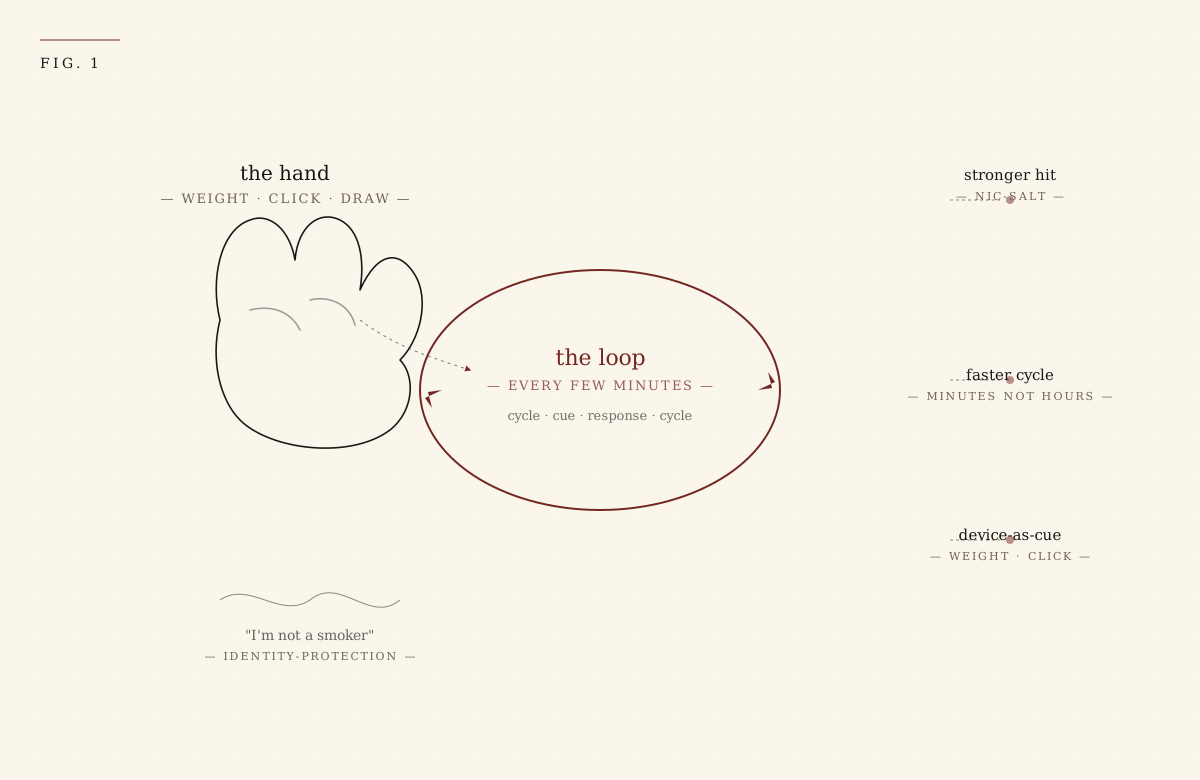
It is also the most accurate description of what happened. The cigarettes were quit — that took years and it was real. The thing that came after was not the off-ramp it was sold as. It was a stronger hit, delivered faster, in a device that lives in the hand. The cycle, the click, the weight in the hand are the cue. The cue can be unlearned.
Cigarettes were a smoke break. The vape is a fidget. The break became the whole day.
Why vaping isn't smoking
The vape is not a smaller cigarette. That is the place to begin, because almost every quit-vape attempt assumes it is, and almost every step of the failed protocol — step the nic down, switch to a smaller pod, throw the device away on Sunday and buy another on Tuesday — assumes the pattern is the same shape as the smoking habit, only weaker. It is not. It is built differently. Three things make it so.
The first is the architecture around the chemistry. A cigarette had to be lit. It needed a step outside, a lighter, a four-minute window with nothing else in it. The nicotine was real, but the day put friction around the delivery. A nic-salt pod has none of that friction. It is a smoothed-out, throat-comfortable form of nicotine at concentrations the lung will accept in a single draw, and it sits in a pocket. A modern nic-salt disposable can hold the nicotine of a full pack of cigarettes or more in a pocket-sized device.1 The hit comes faster than a cigarette ever did, fades sooner, and asks for the next one in minutes rather than hours. The Truth Initiative's quit-program data: more than nine in ten enrolees vape nicotine daily; eight in ten reach for the device within thirty minutes of waking.2 That is not a habit. It is a cue density that smoking, as a delivery system, was not capable of producing.
The second difference is the device itself. A cigarette wasn't there when it wasn't being smoked. The vape is. It has weight. It has a click as the magnet seats. It has a particular fidget — the rotate-in-the-palm, the tap-against-the-desk, the unclip-and-reclip — that the hand learns the way a hand learns a wedding ring. The cue isn't only the chemistry. The cue is also the object. Smoking didn't give the hand an object to wear all day. Vaping does.
The third difference is the quietest, and the heaviest. The cigarette came with a name and the name carried weight — smoker — and at some point a person could look at the name and say no, and do the work to step out from under it. The vape came without that name. I'm not a smoker did real work for ten years. It got the cigarettes quit. It is also the reason the new pattern didn't read as a problem until recently. The part of a person that watches for dependency was watching for the smoker-shape, and the vape didn't have that shape, and so the habit slipped under for a long time.
This is why stepping down the nic, on its own, doesn't do the thing. Lowering the milligrams reduces one input. The cue is still firing — the cycle, the click, the weight, the draw — and reduced chemistry into an unchanged cue is still a habit. It is also why the Allen Carr book works for a week and then doesn't, and why the zero-nic pod lasts four days. The cognitive frame addresses the chemistry argument. It does not retrain the hand.
Hypnotherapy targets the cue, not the chemistry. The cycle, the click, the weight, the draw — these are what the protocol retrains. The withdrawal works through on its own timeline. The pattern above it is what changes.
A morning the hand stays still.
When the hand stops
It is an ordinary Wednesday. Marcus wakes, and the first thing his hand reaches for is the pillow, then the phone for the time, then the kettle in the next room. Somewhere in there it occurs to him that the device is not in the bed. It might be in the drawer. It might be downstairs. He does not quite know. The morning continues without him knowing, because the morning has more in it now than the device.
A thirty-minute meeting at the desk — the kind that used to need an under-desk pull every five minutes, the kind that used to be a count of how soon he could step away. The meeting ends. The device is sitting on the corner of the desk where he left it before joining the call, untouched, and he notices it the way you notice a coffee cup you forgot to drink. He smiles, briefly, on his own. Nothing to mark, nothing to celebrate. The hand stayed where the hand was meant to stay.
In the evening there is a stretch of nothing — that weeknight half-hour between dinner and bed where the device used to live in the palm by default. The boredom of it feels the way other people's boredom feels: small, ordinary, manageable. Nothing to fidget with and nothing to fidget away. The hand at rest is its own kind of presence. He goes to bed earlier than he used to. The bedside is uncluttered.
This is not the absence of having ever vaped. It is the absence of the cycle. A morning that begins elsewhere. A meeting attended at the same scale anyone else attends one. An evening where the hand has somewhere to be that is not the device.
Marcus got back to the life he wanted. Most people can too — see how, next.
The sessions
These sessions are usually online, by video — once a week, about an hour each. You sit at home, comfortable and in control. There is no waiting room and no commute, which some people find helpful on hard days.
The first session is mostly conversation. I ask about the smoking — when you started, when you stopped, what the years on cigarettes were like — because the work begins by honouring that quit, not skipping past it. Then I ask about the device. What you use. How long you've been on it. The strength. The cycle through a typical day. The cues — the morning, the car, the meeting, the after-meal, the boredom, the under-desk pull, the bag-check before walking out the door. Then I guide you for the first time into the focused, relaxed state hypnotherapy uses. People sometimes expect to be unconscious, or unable to remember what was said; that doesn't need to happen. You're almost always awake, you hear me, and you can reject anything I say at any point. Hypnotherapy is similar to the state of being engrossed in a story — a focused, narrow attention, calm and centered.
The middle sessions are normally where we work at the core of the issue. We work with the layer that learned the pattern — the device weight, the click, the draw, the hand-reach, the cycle frequency, the specific times of day when the pattern is loudest — and we work on breaking those patterns. The imagery is calibrated to your device: the disposable, the pod, the mod each carry a different cue map, and the work adapts. We deal with those cues in safe, structured, supported ways, to let those old patterns settle into new instructions. Between sessions you have an audio recording — I make it for you — that you'll listen to most days. Some clients begin to notice shifts by the second or third session. Some take longer. Hypnotherapy compounds — not only at each session but even in the time between sessions. The subconscious is always processing — always growing.
The closing session is integration. We review what has settled, what has shifted, and what to do if a cue tries to fire again later — we talk about how to respond so you are confident about what to do after the sessions. By this point most of my clients have noticed shifts they can name — a morning the hand didn't reach, a meeting that didn't require the under-desk pull. Cravings can return for weeks after the sessions end, and a cue that fires once is not a relapse if you respond to it without reinstalling the pattern. Many clients quit fully at session two or three and don't need the fourth. Some take all four. A minority don't fully respond.
The published cohort response rates for cessation hypnotherapy are what they are. They are stronger than for nicotine replacement alone. Vaping-specific clinical trials of hypnotherapy are still few; I will not promise you a number. What I will promise is honest measurement. We track your cycle count and your craving severity from week one, and if by the middle of the package you are not responding, we will have a conversation about whether to continue, refer, or stop. You will be refunded for the remaining sessions.
A note from the practitioner
I am a Christian, and I work as a clinical hypnotherapist. Yes, Christian hypnotherapy is not just possible — it has proved to be good and helpful to many fellow Christians over the years.
If your faith is part of how you carry your life, you may be wondering whether Christian Hypnotherapy belongs in the same room as your prayers. The short answer is yes. The longer answer is in the Christian Hypnotherapy Guide, which I would encourage you to read if you would like more depth. In summary: the focused state we use in a session is not a spiritual state. It is the same calm, narrow attention you have probably been in while reading a good book, watching a good movie, or contemplating a Psalm. Romans 12:2 asks us to — be transformed by the renewing of your mind. The mind has layers. Thoughts and talk reach the surface. The deeper layers respond to medication — and hypnotherapy. And unlike medication, hypnotherapy has no side effects to worry about. Just the ability to use your brain to its best natural capacity.
If you came from cigarettes through a vape and you are now trying to step out from under the vape, you have already done the hard part once. I will not call you a smoker, because you are not one. I will not call you a vaper either, because that label is doing more harm than good. I will name the cue — the device, the click, the weight, the cycle — and I will help your nervous system unlearn it.
(If you are not a Christian you are welcome as well. Hypnotherapy still works. I am trained, skilled, and I deliver results.)
I have watched vaping run the same pattern in faithful men and women — for years. The vaping habit is not a failure of faith. It lives in the layer below your thoughts. That is what hypnotherapy reaches. And that's what we can use to bring about real change together.
— Charles
Read the full Christian Hypnotherapy Guide →
Charles Lobo
Clinical Hypnotherapist · Diploma, Australian Academy of Hypnosis · Member, ASCH
Frequently asked questions
Will I have withdrawal? Vaping withdrawal is rough — what does hypnotherapy do for that?
Withdrawal is real. Most people coming off nic-salt pods or mods describe the first one-to-two weeks as the hard window: jitters, broken sleep, low mood, brain fog, the sense of needing-to-hit-something that is not the same as wanting-to-hit-something. The work I do does not lower the chemistry-withdrawal directly; that wears through on its own timeline.
What hypnotherapy does is reduce the cue-firing. The morning hand-reach, the under-desk pull, the after-meal cycle — those soften over the protocol, which means by the time the chemistry-withdrawal is at its loudest, the cue isn't firing in the same density on top of it. Many of my clients say the withdrawal was harder than they expected — and the cravings, quieter. The two work on different layers.
I tried stepping down the nic. It didn't work. How is hypnotherapy different?
Stepping down the nic addresses one input — the chemistry. It does not retrain the cue. The cycle, the click, the weight in the hand keep firing on schedule even at three milligrams, which is why most people who taper plateau at three or six and cannot make the jump to zero. The work I do targets the cue directly. By the time the chemistry comes off, the pattern above it is not waiting for it.
I quit smoking by vaping. Was that wrong?
No. Switching from cigarettes to a vape was a real reduction in tar, in combustion, in the specific harms that smoking causes. It was also a real piece of work — quitting cigarettes is not nothing, and you did it. I will not relitigate that. The page is here for the next step, not the last one.
I'm Christian and I'm not sure hypnotherapy is allowed for me.
That is a reasonable question, seriously, and you can find an in-depth answer in the Christian Hypnotherapy Guide. The short version: the focused mental state we use in a session is not a spiritual state. It is the same calm, narrow attention you have experienced when engrossed in a good book, or a good story, or in contemplation — you are still awake, aware, your own master. Hypnotherapy works on the physical body and mind, not on the spirit. You remain in control. You can reject anything I say. There is no surrender of will. Hypnotherapy is safe, effective, and powerful.
I started smoking again because my vape ran out and I panicked. Can you help with both?
Yes. If both patterns are live — vaping as the dominant cycle and the occasional cigarette when the device fails — we work both. If smoking is the dominant pattern and vaping is intermittent, the smoking page is the better entry point and the work I do there is calibrated to that. The discovery call assesses which is which.
What if it doesn't work?
Most of my clients respond fully. A few respond partially. A minority do not respond. In the discovery call we can assess your fit. If by the middle of the package you are not responding, we will have a conversation about whether to continue or to refer you elsewhere — for a different modality. You will be refunded for the remaining sessions. But it rarely happens. If you are willing and sincere, Christian Hypnotherapy has a great chance of working for you.
Twenty minutes, on video.
We talk about the device, the cycle, the quit attempts so far, where you are now. You can ask me whatever you need or want to know. At the end the call you will be confident either yes — this is the right next step for you. Or no — this is not the right next step, and here is what else might be, whether that is a referral, a different modality, or a question worth taking back to your GP or your Christian counsellor.
The honest no is the reason the call exists in the form it does. It is not a sales pitch, not a session in disguise, not a hypnosis demonstration — is this the right next step for you — answered together.
A private Christian hypnotherapy consultation with Charles. Twenty minutes by phone or video. AU$25 credit to your first session.
The cue, the click, the weight in your hand can be retrained.
The next step is a 20-minute conversation.
You have lived with vaping for long enough to know what it costs you. Another year of it will cost more of the same. Twenty minutes of conversation costs almost nothing — and at the end of those twenty minutes you will know whether this is your next step, or it isn't. Let's talk.
Start HereA private Christian hypnotherapy consultation with Charles. Twenty minutes by phone or video. AU$25 credit to your first session.